How Tabs used the Crossbeam MCP to turn closed-lost deals into 4–5x more partner-sourced deals
- Win back closed-lost deals
- Spot new economic buyers
- Deliver daily partner signals in Slack
- Enrich outbound when a partner can’t intro
- Co-sell with context


Tabs is a revenue automation platform that uses AI agents to handle what finance and accounting teams do after a B2B contract is signed. That includes invoice generation, collections, revenue recognition, and cash application. Its partnerships team works across private equity firms, accounting firms, systems integrators, and a product partnerships group that builds integrations with ERP, tax, and data providers.
When Tabs looked at why deals were slipping away, the answer was rarely the product. Most prospects were locked into contracts with another vendor and asked Tabs to check back later.
Kaveh Sarhangpour, who leads product partnerships and strategy at Tabs, built a daily workflow with the Crossbeam MCP, HubSpot, and Claude to catch those accounts as soon as they reenter a buying cycle with one of Tabs' partners.
Today, it is the first thing the company's account executives see every morning.
The problem: good deals lost to bad timing
Kaveh spent years in partnerships at SMB-focused companies, where overlapping customers created value almost immediately. B2B finance software works differently. Tabs' buyers usually sign one-year or multi-year agreements, so a strong pitch often lands in the middle of someone else's contract.
When the team dug into its lost deals, the pattern was clear. "The good news and bad news was that 70% of all of our deals in our funnel, hundreds of deals every quarter, were lost due to timing. Not product gaps, not competition, not anything else," Kaveh said. Prospects were still under contract with another vendor and asked Tabs to pick things up again in nine months.
Coming back at the right moment was the hard part, and so was reaching the right person. "It's really hard keeping track of when renewals are actually going to be coming up. You're relying on a lot of CRM hygiene," Kaveh said. "Another scenario we see quite often is we're trying to outbound one contact. That contact is either no longer in that company or is not the buyer anymore."
How they built it: a daily partner signal for every lost deal
Tabs sits in a crowded office-of-the-CFO market alongside tax, ERP, CRM, and CPQ providers. When those partners open a deal with one of Tabs' lost prospects, it is a strong sign the account is back in market. The Crossbeam MCP made that signal visible.
"With the MCP, we found out that we have the ability to actually see: did one of the prospects, open opportunities, or closed-lost deals in our HubSpot move into a buying cycle, as shown by the stage field in Crossbeam, with another company that we're partnered with?" Kaveh said.
From there, he built a workflow to catch that signal automatically.
01 Map closed-lost deals against partner pipeline
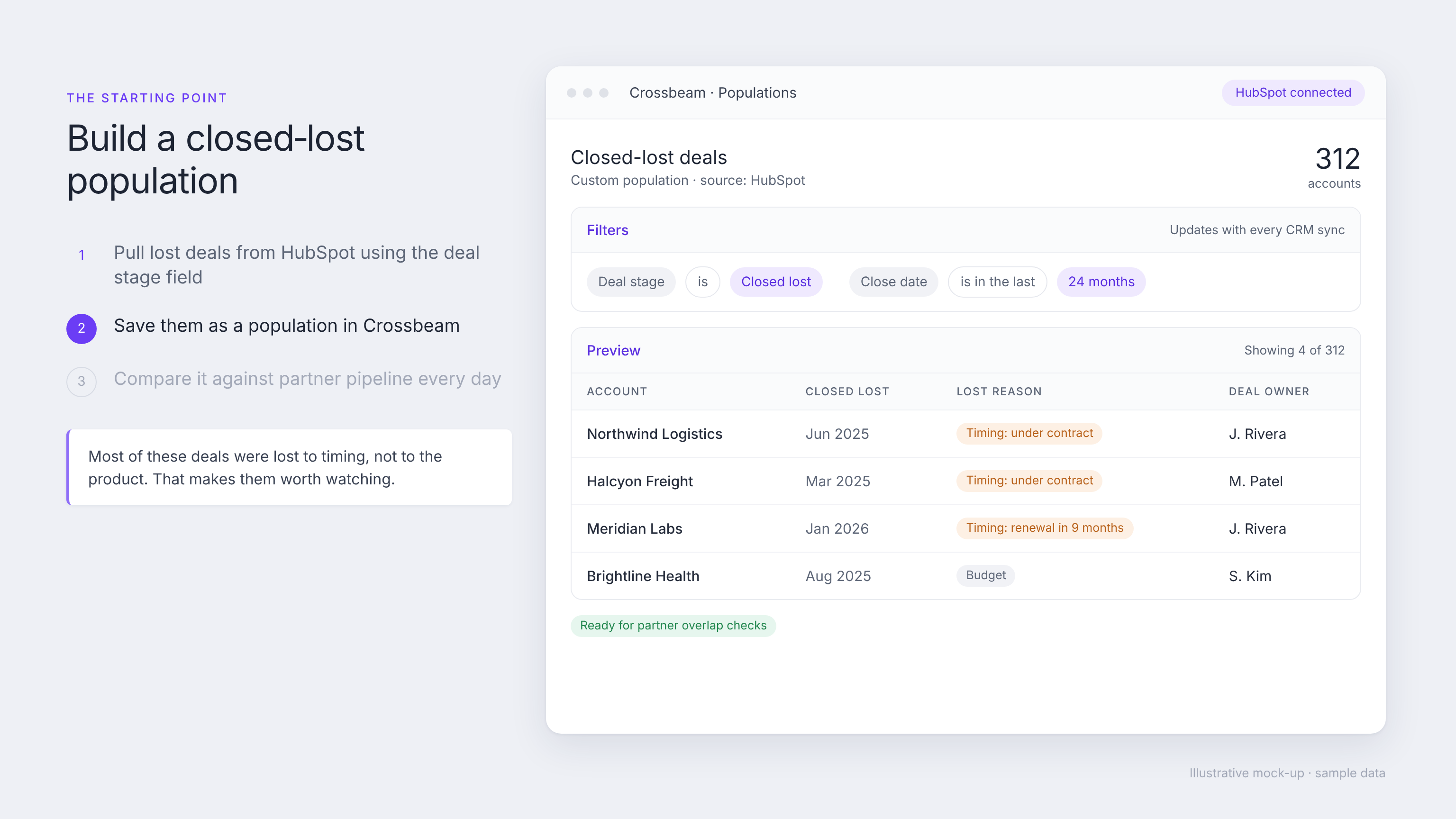
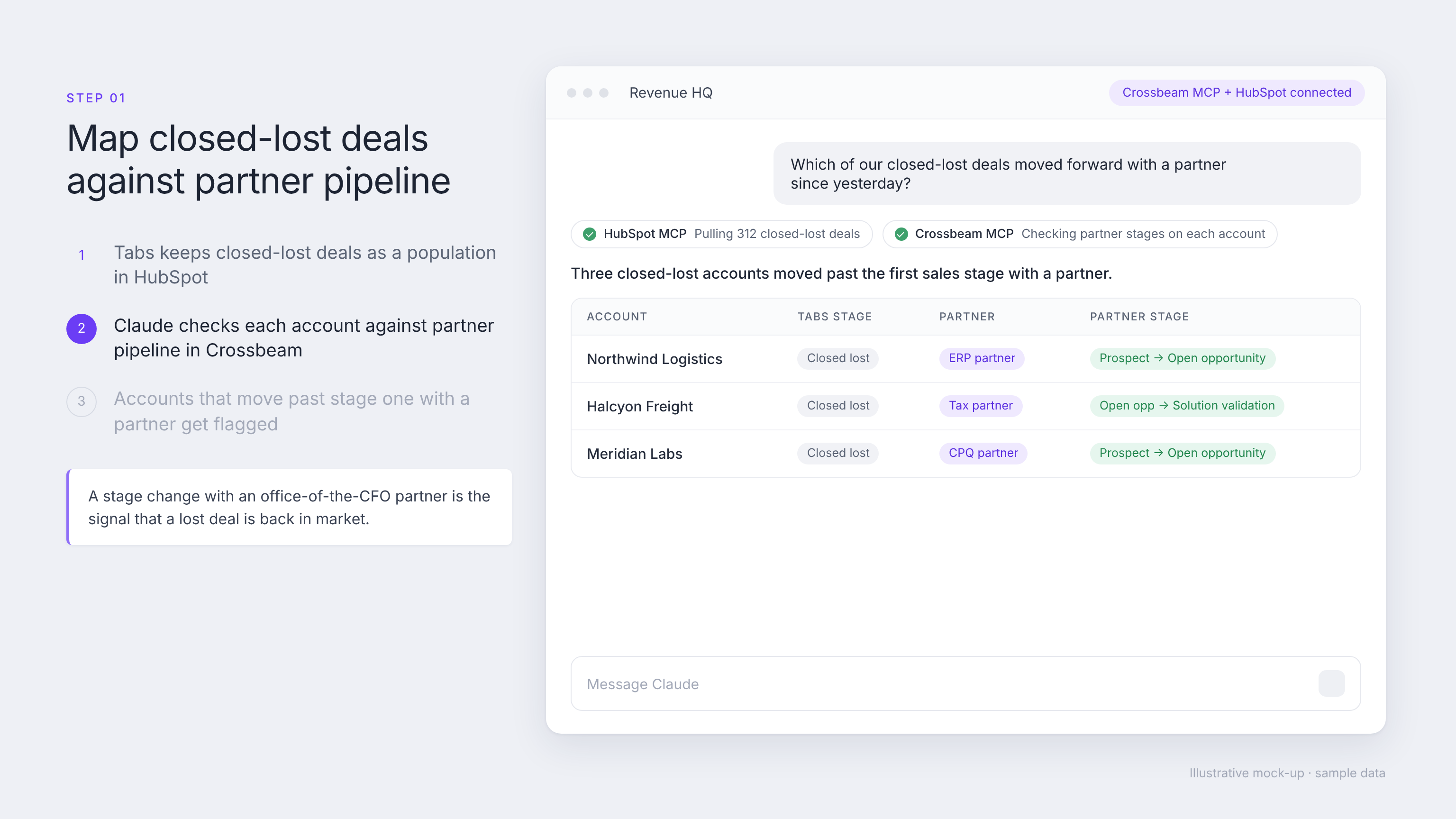
Tabs keeps a closed-lost population in HubSpot, defined by the deal stage field. Using Claude connected to the Crossbeam MCP and the HubSpot MCP, the team maps those accounts against partner overlap data in Crossbeam. Any time a lost account moves past the first sales stage with a partner, such as from prospect to open opportunity or into solution validation, it gets flagged.
02 Capture the details that shape the ask
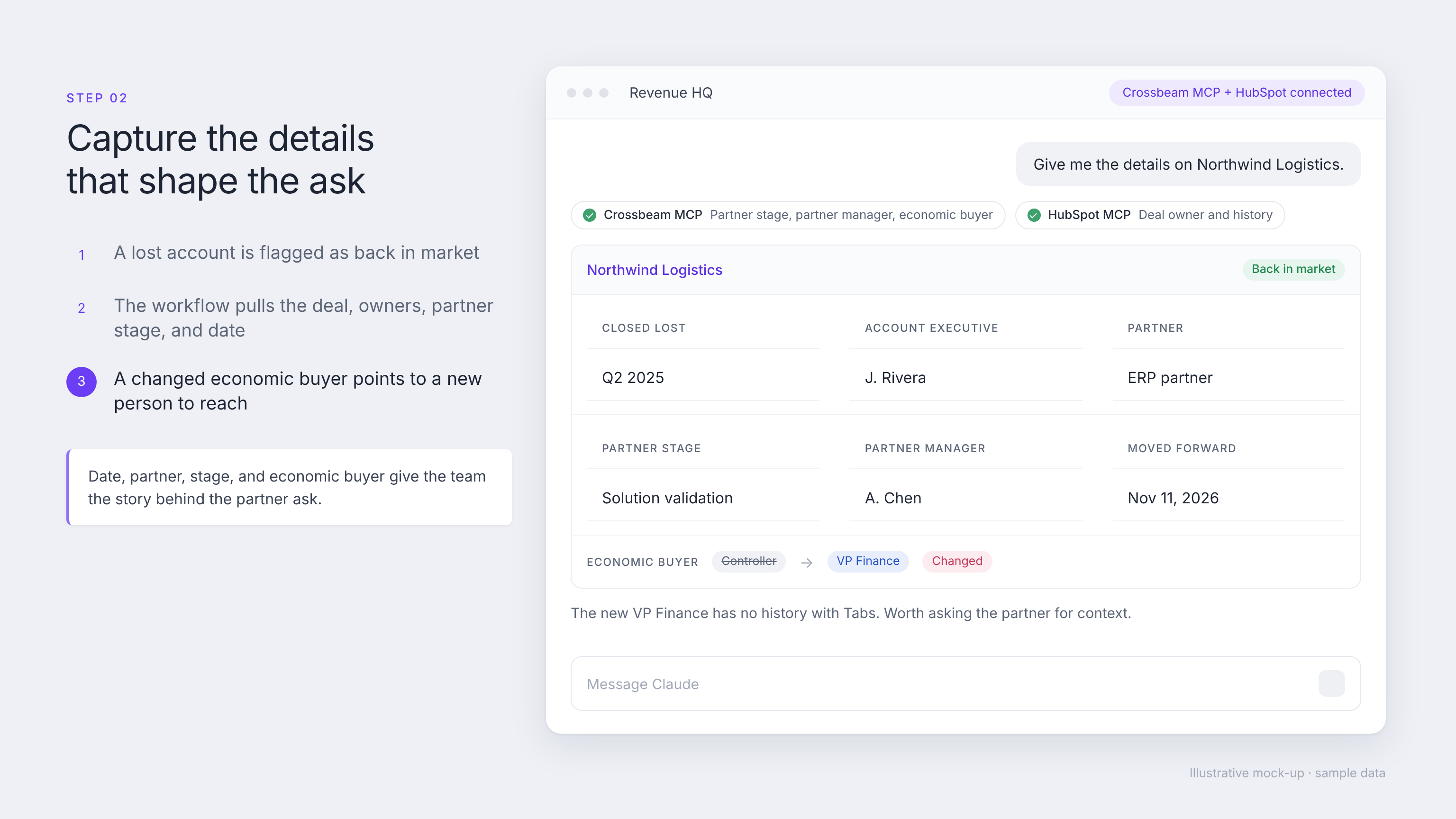
For every flagged account, the workflow pulls the details the team needs to write a useful note to the partner.
"If a closed-lost opportunity becomes an open opportunity or moves into solutions validation with one of our partners in the office of the CFO, we will actually be able to see which deal, who is the account executive, which partner, who is the economic buyer, who is the partner manager, and what date they moved forward," Kaveh said.
The economic buyer field matters as much as the stage, because it often reveals a decision-maker Tabs had never spoken with. "One thing we track using Crossbeam is also who is the economic buyer on our partner side, and is that potentially a new contact we should be interacting with that previously we weren't interacting with," he said.
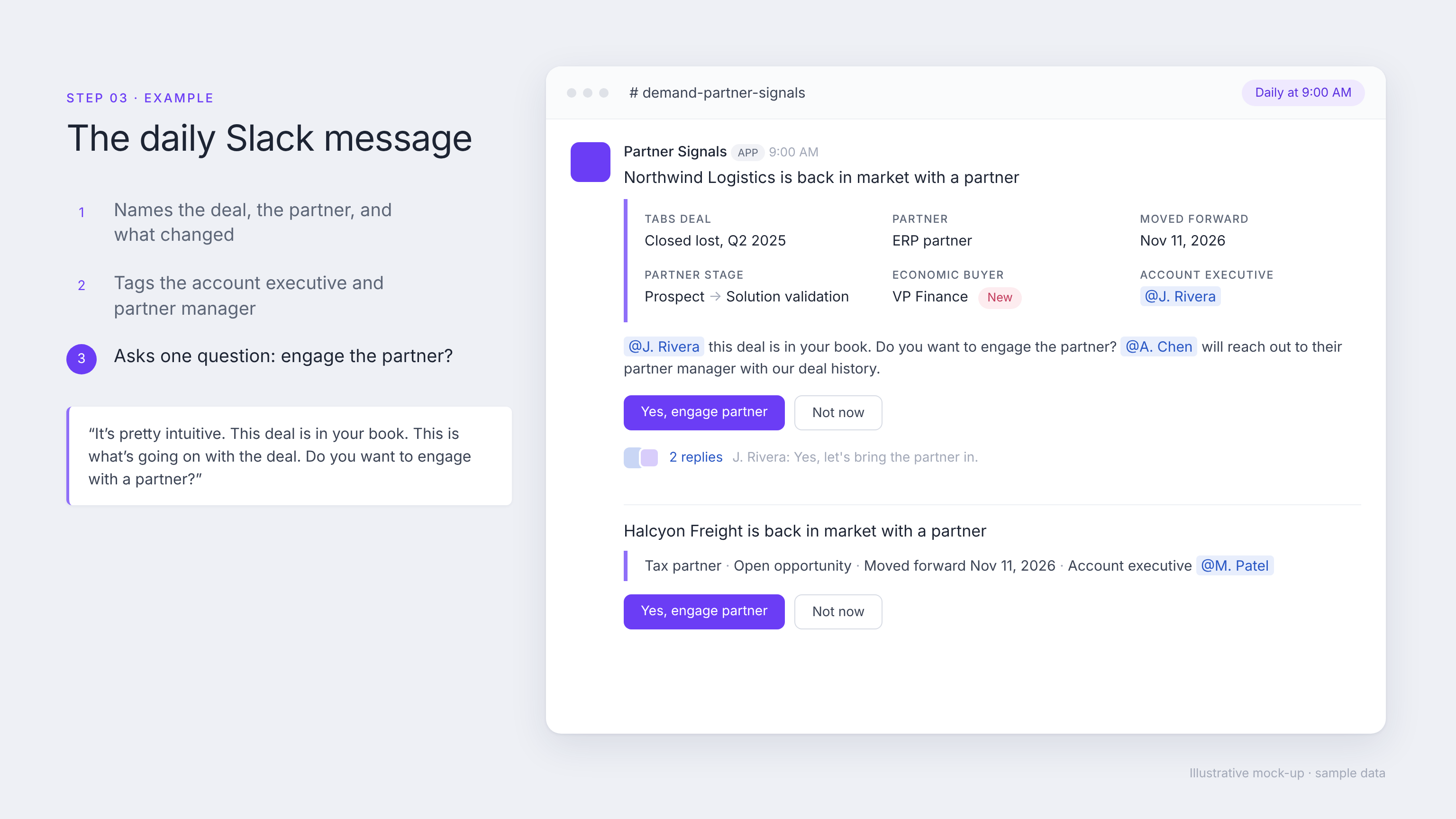
03 Deliver a 9 a.m. digest in Slack
A scheduled run posts the results once a day to a Slack channel shared by the demand team. It tags the account executive and the partner manager on each deal so they can decide together whether to engage the partner. Because it runs at 9 a.m., it has become how Tabs' sales team starts its day.
Adoption took very little enablement. Account executives have pipeline goals, and the thread asks them a simple question about a deal already in their book. If they say yes, the partner manager takes it from there.
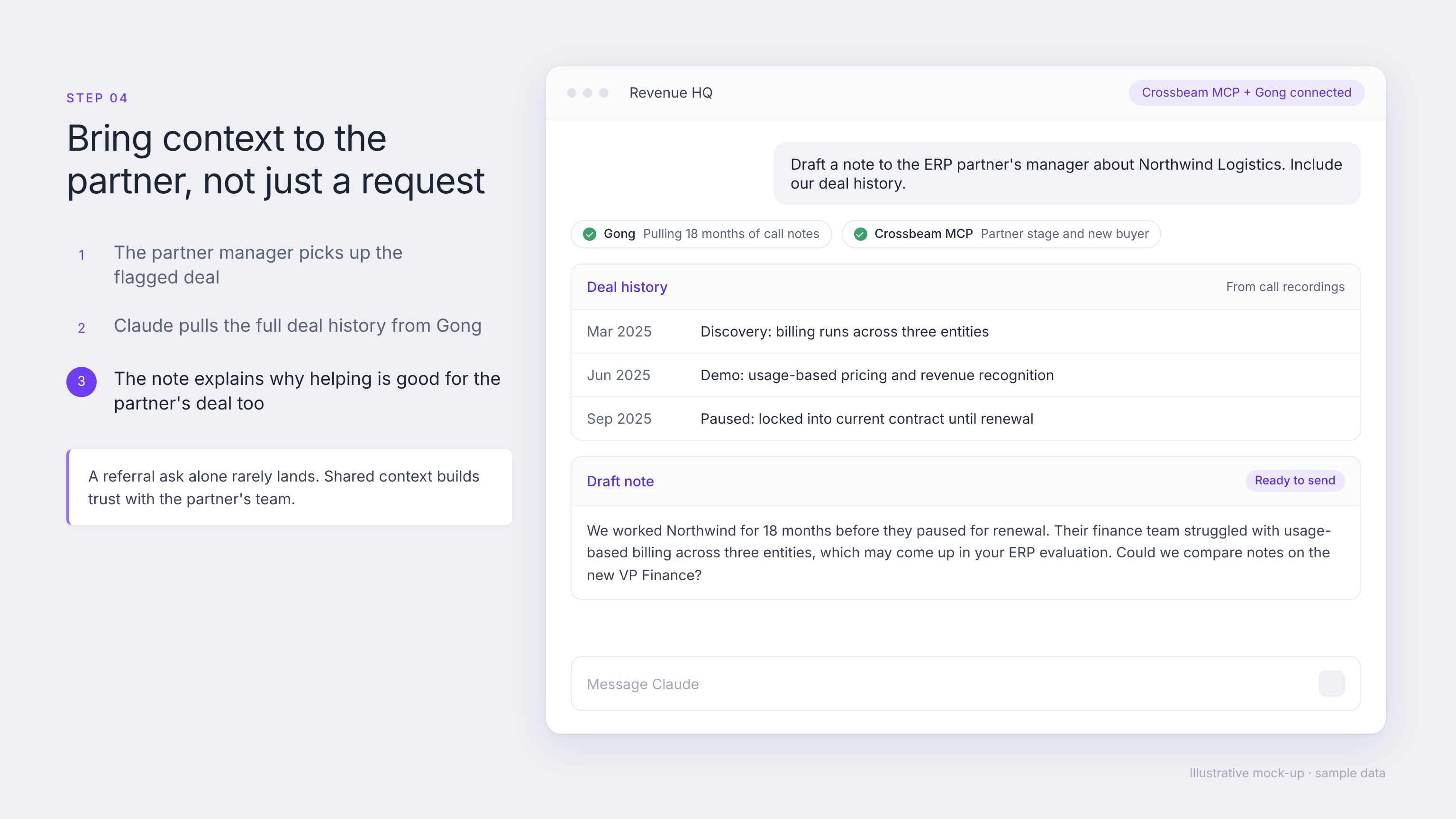
04 Bring context to the partner
Before reaching out, the team pulls the full deal history from Gong instead of relying on HubSpot fields alone. Partners who already know a prospect can help move stalled deals, but they need to understand why the deal matters to them. That context gives the partner a real reason to help.
"It's fine to go with the ask of 'can you please introduce us to?' I don't think that's typically enough because people aren't there just to give you referrals," Kaveh said.
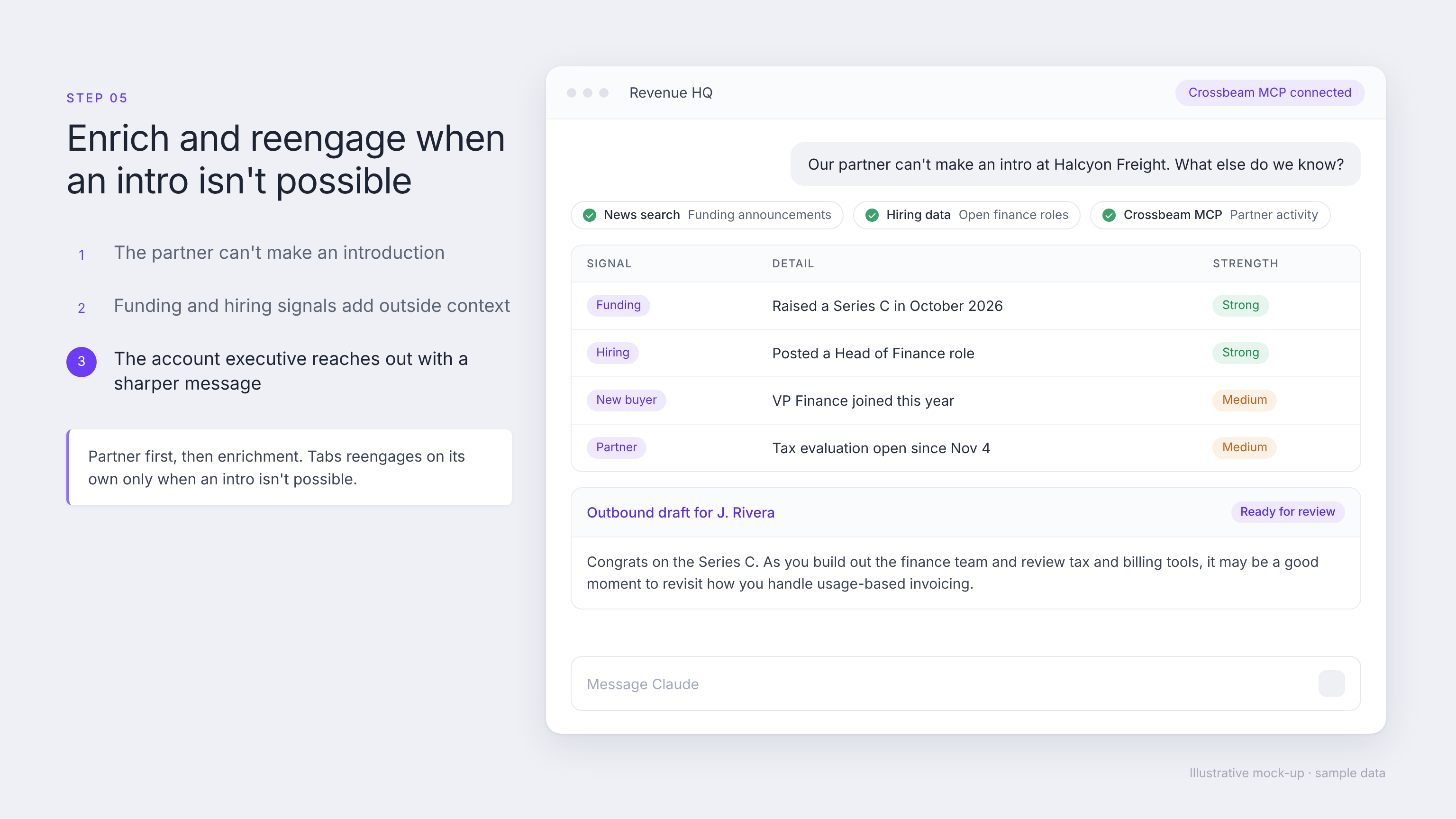
05 Enrich and reengage when an intro isn't possible
If a partner can't make an introduction, a second workflow kicks in. The team layers in third-party signals, such as funding news and hiring activity for finance roles, to build a better-informed outbound message on its own.
What happened: a six-figure co-sell deal and 4–5x more partner-sourced deals
One deal shows how the workflow plays out.
Tabs had spent about a year and a half pursuing a company with nine-figure annual recurring revenue (ARR). The prospect asked the team to check back in six months, and the original contact went silent. Once the workflow was live, it flagged that the company had entered an ERP buying cycle with one of Tabs' close partners and that the economic buyer had changed.
Tabs shared its 18 months of deal history with the partner, which helped the partner run a faster, better-informed sales cycle. The partner also realized it couldn't cover the revenue and billing side of the business. It brought Tabs into a meeting, reintroduced the team to the new economic buyer, and the two companies closed it as a co-sell deal worth six figures on each side.
The broader numbers moved too. Under the old enablement-heavy model, Tabs averaged one or two partner conversations a week. With the daily run, it now sees more than a dozen, and partner-sourced deals are four to five times higher (Tabs tracks partner-sourced and partner-influenced revenue through custom fields in HubSpot).
The role of the partnerships team has shifted as well. "You essentially become an editor or an auditor of open opportunities as a partner manager versus necessarily a net new sourcer," Kaveh said.
A final thought
If a large share of your lost deals comes down to timing, your partners may already know when those accounts are back in market. Their pipeline tells you who is evaluating, who the new buyer is, and when the window opens. A simple daily check against that data turns a pile of "check back later" deals into a steady list of reasons to call a partner.
Kaveh's advice is to start small and keep it to one or two objectives. Connect your CRM and Crossbeam, look for timing signals, and see how your partners respond before you add more tools.
"I think catching people in the deal cycle makes them want to collaborate more than catching them when the customer's already closed to make what can feel like a random referral at times," Kaveh said. Crossbeam's own ecosystem team works the same way, and it turns partner signals into bigger deals. That is the heart of Ecosystem-Led Growth.
Build your own closed-lost partner signal
Want to spot lost deals coming back to life like Tabs does? Book a meeting with our experts to learn how the Crossbeam MCP works in the AI tools your team already uses, including Claude, ChatGPT, and Glean.
Book a meeting with our experts.
Frequently asked questions
What signal does Tabs use to know a closed-lost deal is back in play? Tabs watches for a lost account moving past the first sales stage with any of its partners. That could mean a partner opening a new opportunity or moving an existing one into solution validation. The workflow also flags when the economic buyer has changed. Together, those details tell the team who to talk to and why now.
Which tools does the workflow use? Claude and Day AI connect to the Crossbeam MCP and the HubSpot MCP to compare Tabs' closed-lost deals against partner pipeline. A scheduled run posts the results to Slack each morning. Gong supplies deal history for partner outreach, and third-party signals like funding and hiring news support outbound when a partner can't make an introduction. For more ways to put partner data to work in your AI tools, see these 15 Crossbeam MCP use cases.
How did Tabs get account executives to use partner signals? Very little enablement was needed. The Slack thread names a deal already in the account executive's book, explains what changed, and asks whether to engage the partner. Because account executives carry pipeline goals, any context that helps them reopen a deal gets used. The partner manager handles the conversation with the partner from there.
How does Tabs set rules of engagement with partners? Tabs only signs product partners who agree to share data on Crossbeam, and that commitment is written into the partnership. The team does not share one partner's data with another, does not disparage partners, and never implies an endorsement it doesn't have. It also avoids mass emails to a partner's customers, which keeps each partner in control of its own brand and messaging.
Can this run in real time instead of once a day? Yes. Tabs built a daily scheduled run, but Crossbeam AI Automations can send a Slack alert the moment a partner opens a new opportunity on a mutual account. Crossbeam's own team uses webhooks and partner signals the same way to reach prospects while the momentum is fresh. Either option removes the wait for the next morning's digest.
This story comes from the webinar "How Tabs Uses AI to Revive Closed-Lost Deals with Partner Signals," part of the MCP Ecosystem Playbook Webinar Series. Watch the complete interview here.
Explore features built for

Trade in your spreadsheets and surface the most promising opportunities in your ecosystem with Crossbeam’s pipeline matching engine.

Keep pace with your partner pipeline. Monitor trends with partners and action ecosystem opportunities with a birds eye view into your revenue engine.

Stay up to date on accounts and keep things moving by sending notifications where work happens. Makes moves faster with real-time notifications in Slack and Email.

Connect your partner data anywhere. Get your ecosystem engine going with integrations that fuel your go-to-market teams and business outcomes.