How Crossbeam’s Ecosystem Team Turns Partner Signals Into 350% Bigger Deals in 2025
- Prioritizing high-intent ecosystem signals
- Accelerating partner-sourced revenue
- Building self-updating target lists in Salesforce
- Personalizing outreach with Ecosystem Intelligence
- Measuring and scaling ecosystem performance
.png)


Disclaimer: This case study spills a few of our secrets. Feel free to borrow what works, and leave the rest.
When we set out to build a Business Development team at Crossbeam, we knew it wouldn’t follow a traditional outbound motion. There would be no cold calls or cold emails.
From day one, the goal was to create a team built entirely around Ecosystem-Led Growth (ELG), one focused on activating and generating revenue through both our strategic partners and our largest customers.
That’s how the Ecosystem Team was born: a group dedicated to making every ecosystem signal actionable and every partner relationship measurable. Their mission is simple: drive activation and pipeline across the partners of our customers and the partners of our Gravity Nodes.
This empowered team includes Noemie Goubin, Director of Business Development and Partnerships, Kevin Linehan, Director of Partnerships, and Business Development Specialists, Guillaume Dugenet and TJ Turner.
But there was one more challenge that they had to overcome: how to prioritize ecosystem signals (lists, reports, partner overlaps, invites, etc).
“The problem was focus,” TJ says. “There were too many signals coming from everywhere, and no clear way to know which were the strongest. We had to find a system to cut through the noise and prioritize the right accounts. All the signals were great, but we needed to focus on what mattered most and start scoring our accounts.”
Together with leadership and our RevOps team, the Ecosystem team built a process to rank, score, and follow-up with signals, identifying which ones consistently translated into pipeline.
This process shifted how opportunities are sourced, prioritized, and closed, leading to partner-sourced deals showing faster cycles, higher win rates, and deal sizes up to 350% larger than outbound-led opportunities.
Read on to learn how TJ and the Ecosystem team leveraged ecosystem signals to increase deal sizes and qualified pipeline that drives revenue.
The breakthrough: Prioritizing the strongest signals
Not every overlap or invite carried the same weight. Through trial and error, the Ecosystem team narrowed the universe of signals to a few that reliably drove results.
“These partner insights that we're getting directly from partner CRMs — that second-party data — is so unique,” said TJ. “It’s not something you can scrape from AI or from the internet.”
Here are the key signals we prioritize:
- Gravity Nodes Ecosystem: Large enterprise customers with over $500K in ARR potential and strong partner ecosystems that drive customer acquisition and revenue growth for Crossbeam. Acting as “ecosystem magnets,” their partner invites signal clear intent — making those accounts top priority for our team.
- Customers of strategic partners: Customers of certain integration partners consistently prove to be high-value. Why? Because these accounts are already investing in partnerships and eager to operationalize co-selling. TJ uses filters for specific product fields, such as whether an account is a customer, a heavy user, or leveraging one of our strategic partners, to pinpoint the right opportunities. For instance, when Crossbeam data showed over 130 seats purchased through one of our strategic integrations, TJ knew the account had scale potential far beyond a $10K deal.
- Ecosystem size: Beyond product usage, TJ also considers the size and maturity of each company’s ecosystem using tools like Partnerbase, which helps gauge how many active partners a company has and how developed their ecosystem motion is.
Combined with Salesforce ICP filters and partner-shared data on Crossbeam, these insights allow TJ to build precise target lists and set real-time alerts in Slack and email ensuring he never misses a new signal.
All of these signals come together in the EQA (Ecosystem Qualified Account) model, automated in Salesforce and created by Kevin Linehan, Noemie Goubin, and Margaux Faurie (our Operations and AI Associate), the Ops team, and our internal AI Associate.
This model treats ecosystem activity as the single most important form of intent. If two accounts look equally good, the one with partner context always wins.
In practice, it looks something like this:

In addition to strong data, our Ecosystem team’s success depends on collaboration:
- Noémie decides which Gravity Nodes to engage next, drives alignment between BD, partnerships and RevOps work.
- Kevin decides which partners to engage next, drives alignment on joint messaging and co-sell opportunities.
- RevOps create reports and dashboards in Salesforce based on EQA scoring and signals to help BDs prioritize their account portfolio and eliminate guesswork.
Even incentives are aligned. Our Ecosystem team’s goals include not only pipeline creation, but specifically partnership-sourced opportunities. Success means collaboration, and collaboration drives success.
Turning signals into a GTM motion
However, having the systems and scoring models in place wasn’t enough. The team needed to turn them into a repeatable sales rhythm.
“Our first step is leveraging the relationships we have with our Gravity Nodes and their partner managers to start conversations with partners who might be hesitant about the value of an ELG strategy or Crossbeam,” said TJ. “Once we’re in that conversation, it’s key to make Crossbeam’s value proposition clear and highlight how the partner will benefit.”
The Ecosystem team operates on two fronts: activating our customers’ partners and our partner’s customers. The goal is to source new opportunities from these two motions. Here’s how they turn ecosystem signals into a repeatable, high-performing GTM motion:
Step 1: Build a target lists that update themselves
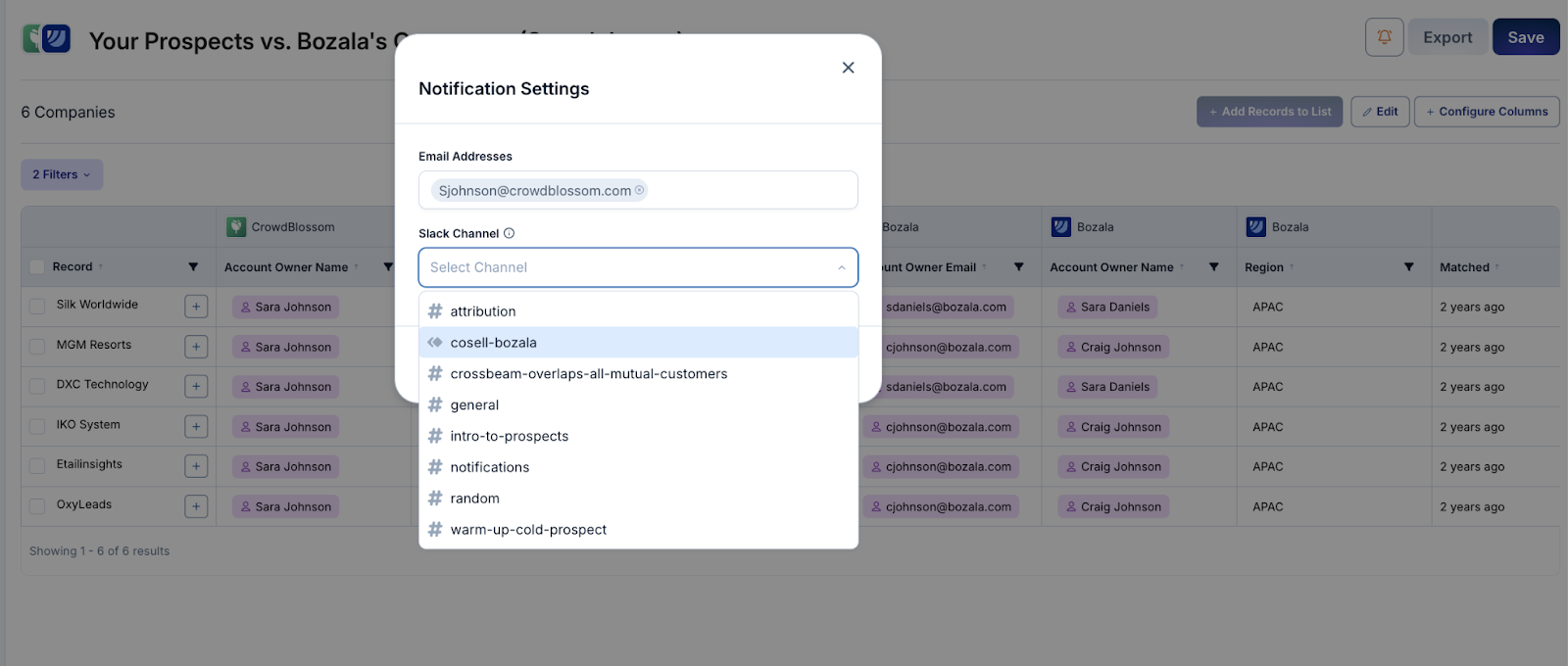
“I’m using both reports in Salesforce and Crossbeam,” said TJ. “But with the way the product’s going, with CRM field mapping and other new features, it’s getting easier to pull custom fields and partner insights directly inside Salesforce. Now, I can do more in the system I use every day.”
On Salesforce (since that’s where TJ lives), TJ and the Ecosystem team embed ecosystem data to build reports include data like:
- EQA signals
- EQA scoring
- Crossbeam fields like: “Is a customer of” and “is an opportunity for”
- Product signals when relevant (for example partner invitations and number of live partners
He also uses Crossbeam to identify which partners his customers and prospects already work with and dig deeper into insights like product type, active integrations, and overlaps and sets up Slack alerts to ensure new matches land directly in his workflow.
*Additionally, our RevOps team enriches our Salesforce reports with other ecosystem signals coming from Crossbeam or Partnerbase such as: number of live partners on Crossbeam, total number of partners on Partnerbase, main partner name.
Step 2: Enrich with the right contacts
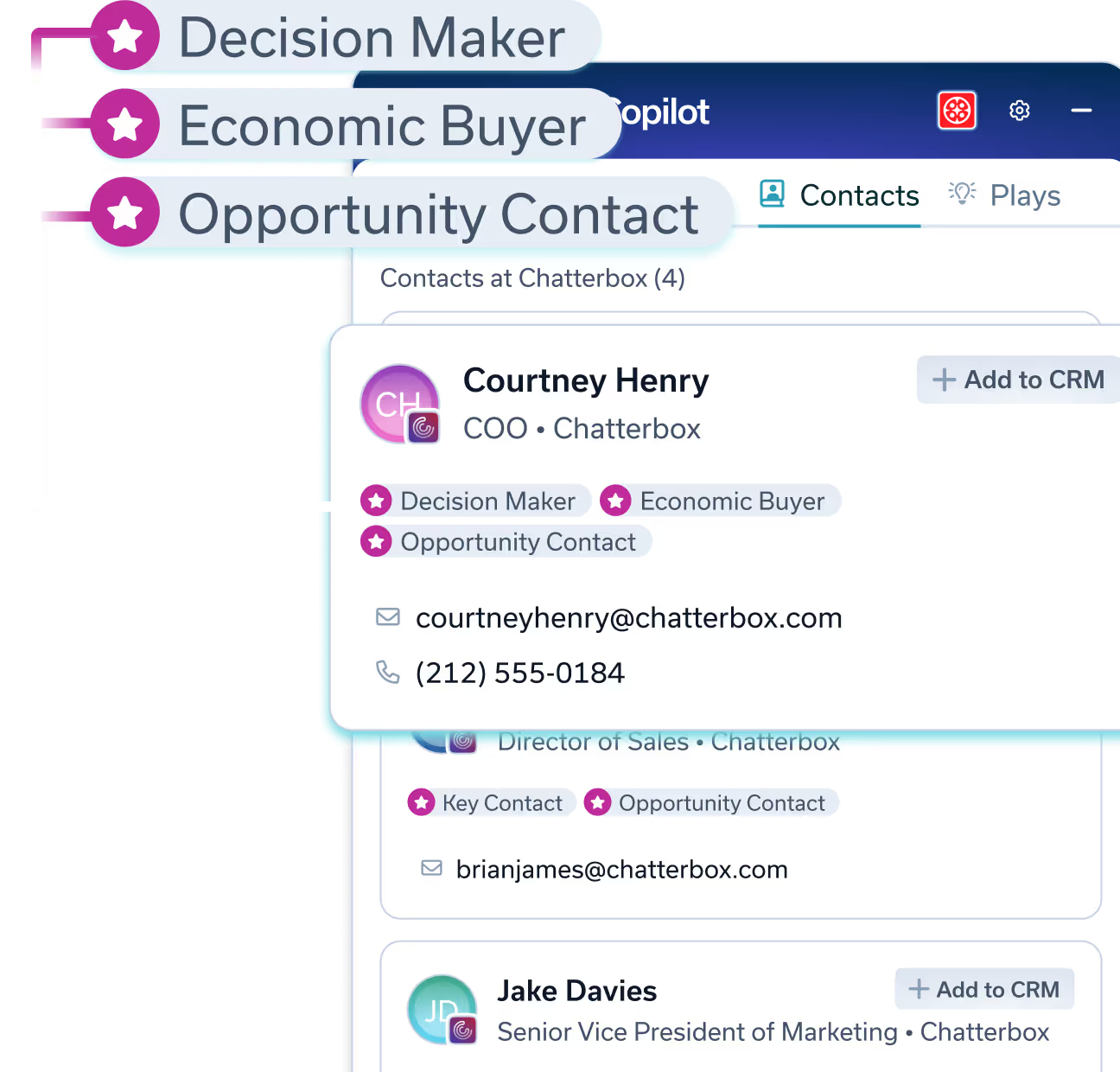
“I get email or Slack alerts every time an account meets our criteria or shows a new overlap,” said TJ. “That’s my cue to take action. I’ll jump into the account, dig deeper to see which other partners overlap, and then craft the right message. The goal is simple: book a call and open some pipeline.”To enrich lists, TJ uses Clay and Crossbeam Copilot:
- With Clay, he fills in org charts to find partnership leaders, RevOps managers, and sales directors, warm entry points even if the partner hasn’t yet joined Crossbeam.
- With Crossbeam Copilot, TJ digs deeper into partner data, exploring shared custom fields and partner contact information (using the Contact tab in Crossbeam Copilot) to understand partner engagement and relationship depth. He then decides which partner and which best contacts to work with in our network are best positioned to move the opportunity forward, supplementing this with partner impact metrics from Crossbeam.
Step 3: Tailor cadences to signals and personas
In Salesloft, no cadence is one-size-fits-all. Gravity Node invites get one sequence; strategic integration partner customers get another. In this case, messaging shifts by ecosystem signal and persona: partnership leaders cared about ecosystem visibility, RevOps about CRM plumbing, sellers about faster cycles.
“Having these signals lets us find creative ways to break into accounts that aren’t your typical cold, outbound emails,” said TJ. “Existing relationships are much stronger than going in cold.”
“The key is understanding each persona and using the right signals to tailor your messaging,” he added. “Once you’ve done that, it’s about putting them into the right cadence with that personalized message. From there, the goal is simple: book a call and open an opportunity.”
Step 4: Prove value early
First calls are all about action. Thanks to Crossbeam’s integration with Salesforce, TJ gets ecosystem data flowing into the CRM right away, whether the opportunity was sourced from a Gravity Node customer or a partner overlap. Having that ecosystem context directly where our team already works means there’s no need to toggle between tools or chase data — turning the first call into a strategic, ecosystem-driven conversation instead of a cold start.
To support this, Kevin and Noémie built a Partnerships Notion page outlining different value propositions to support conversations to connect with a Gravity Node on Crossbeam during the first call:
- If the prospect comes from a partner overlap, walk them through the joint value proposition and the outcome you can deliver together.
- If the prospect comes from a Gravity Node ecosystem, lead with the benefits of connecting to the Gravity Node on Crossbeam. For example, easier data sharing with their partner network, faster co-selling, and clearer visibility into mutual customers — and explain how that connection unlocks the next steps.
Once interest and fit are clear, TJ introduces the account to Enterprise AEs. TJ demonstrates quick wins, while the AEs show how to scale success.
After getting context from TJ, the Sales team then leverages the EQA model, partner insights (to know more about the buying cycle, procurement process, etc), and just in case they need it, there’s a list of fast facts for AEs on Notion.

What began as a pile of disconnected signals turned into a consistent, repeatable rhythm: identify → enrich → tailor → activate → handoff.
Step 5: Measure success
The Ecosystem team tracks ARR and pipeline generation in Salesforce dashboards aligned with their quarterly goals. In this case, RevOps ensures data is clean, signals are current, and insights are visible to everyone.

The results: From noise to numbers
This ecosystem-first motion changed more than just metrics, it changed how Crossbeam sells.
“After a year of implementing this program, 54% of my opportunities have a Gravity Node or a partner attached,” said TJ.
For example, one of TJ’s mid-market accounts initially showed mild interest in a free plan. It looked bleak until he noticed they were already a strategic integration partner customer. By reframing Crossbeam as a way to unlock more value from that existing platform, he turned a $10K Connector opportunity into a $35K+ Supernode deal.
“When one of our prospects is already a customer of our strategic integration partners, the deals consistently come in bigger,” said TJ. “Those teams are already structured for partnerships and ready to act. Partners already have credibility with the people we’re trying to reach. Leveraging those connections gives us access and trust.”
Thanks to this success — and some ambitious goals — our Ecosystem team has expanded, welcoming three new hires.
“There’s a huge difference between deals that have a partner attached and those that don’t,” TJ added. “Deals coming from strategic integration partners are, on average, 3.5x bigger. Our integrations strengthen our product.”
Lessons for other teams
Our experiment to “drink our own champagne” became proof of concept. Ecosystem-Led Growth (ELG) isn’t just something we preach — it’s how we win.
However TJ also shared three things to make this motion a bit easier:
Our Ecosystem team turned noise into numbers. By focusing on Gravity Nodes, strategic integration partner customers, and real-time alerts, we built a system where every signal became a motion, every motion became collaboration, and every collaboration turned into bigger, faster, better deals.
If you want to discover more secrets and learn how to replicate this success, we’re happy to show you. Book an ELG Strategy call with our team here.
Explore features built for

Trade in your spreadsheets and surface the most promising opportunities in your ecosystem with Crossbeam’s pipeline matching engine.

Keep pace with your partner pipeline. Monitor trends with partners and action ecosystem opportunities with a birds eye view into your revenue engine.

Stay up to date on accounts and keep things moving by sending notifications where work happens. Makes moves faster with real-time notifications in Slack and Email.

Connect your partner data anywhere. Get your ecosystem engine going with integrations that fuel your go-to-market teams and business outcomes.