Score and tier a target account list using Crossbeam data
Layer partner overlap and recent deal activity into your AI workspace to prioritize any account list before you work it.
Get started
Before an account enters your pipeline, you have to decide if it's worth pursuing at all. Firmographic data and intent signals tell you who fits your ICP and who's in market. But none of that tells you whether a partner already has a relationship at the account that could help you get in faster or close sooner.
This play takes any list of target accounts and scans Crossbeam's ecosystem data to highlight those where partner activity suggests a warm path in and buying motion your team isn't seeing yet.
Works for any account list — prospects with no pipeline, open opportunities, expansion targets, event attendee lists, a named account segment. If you have a list and want to know which accounts are worth prioritizing right now, this is the play.
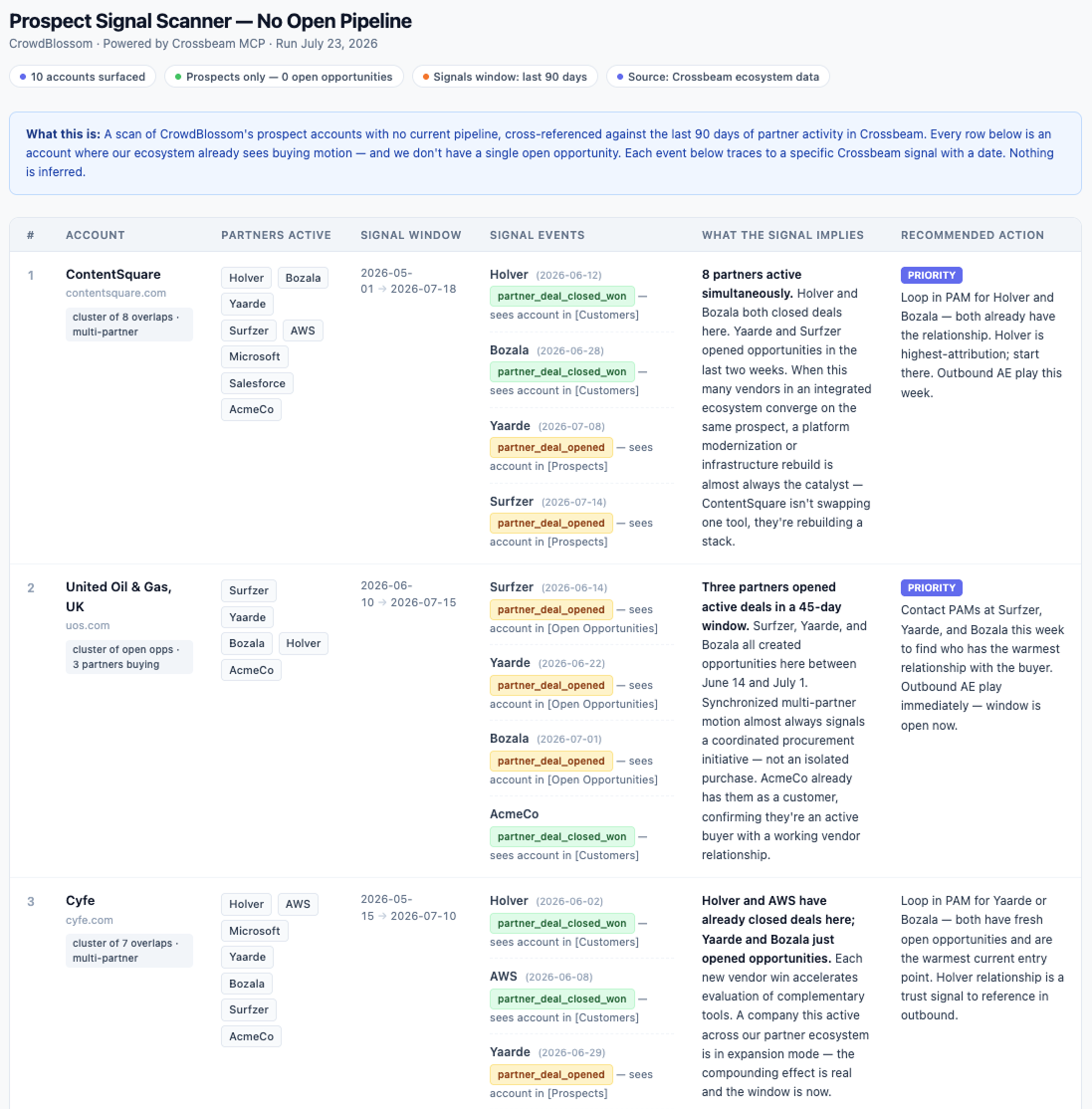
How it works:
- Ask AI to pull a list of target accounts (Prospects, open opportunities, etc, either from Crossbeam or another connected source.
- The AI checks each account against your Crossbeam data and pulls partner overlap and recent deal activity on those accounts
- You get back a tiered list of accounts outlining where partners are active and a recommended next action per account
What you need
- Crossbeam (Supernode or Enterprise plan)
- Your AI tool of choice
- Crossbeam has native connectors in Claude, ChatGPT, and Glean
- For connecting to other AI tools and agents, follow these steps
- Meet data sharing requirements to use partner deal activity signals. Your partner must:
- Have a CRM connected to Crossbeam
- Be syncing and sharing the following fields with you: Deal open date, Deal close date. Deal is closed, Deal is won
Who this is for
SDRs, marketing ops, sales managers, and partnerships managers building target lists who want to know which accounts have a partner relationship before deciding which ones to pursue. RevOps and AI teams who want to automate this as a recurring scoring workflow.
What you'll get
- A tiered list of accounts grouped by partner activity strength
- For each account: the top signals driving the ranking, the partner most relevant to engage, and a recommended next action
- A clear group of accounts with no partner overlap, ready for standard outbound or deprioritization
Steps
1. Set your criteria
Before scanning any accounts, tell the AI what you want to look for. Give it your account scope, signal window, and which partners to prioritize.
Here’s a sample prompt you can customize:
I have a list of target accounts and I want to know which ones to prioritize based on partner activity. Use the Crossbeam MCP connector to check each account and rank them by where the most meaningful partner deal activity is happening right now.
Scope:
- My Accounts list: [prospects, open-opportunities, mid-market prospects, etc.] with no open pipeline
- Signal window: last [30/60/90] days
- (Optional) Partners to prioritize: [list specific partners, or "all partners"]
For each account you find with meaningful partner activity, give me a table with:
- Account name and domain
- Which partners are active and what segment they see the account in (Prospect, Open Opportunity, Customer)
- The specific signal events with dates (partner_deal_opened or partner_deal_closed_won)
- What the signal implies about where this account is in its buying journey
- The recommended next action for our team (which PAM to loop in, what the outbound angle is)
Only include accounts where there has been real partner activity in the last [90] days.
Prioritize accounts with the most partners converging simultaneously.
Output format:
- Produce a [Google doc, PDF, HTML file, etc]
- One row per account in a clean table
- Columns: # | Account (name + domain + signal cluster label) | Partners Active | Signal Window (date range) | Signal Events | What the Signal Implies | Recommended Action
- Signal events should show the partner name, date, and signal type as a colored badge: yellow/amber for partner_deal_opened, green for partner_deal_closed_won
- Include what CRM population the partner sees the account in (Prospects, Open Opportunities, Customers)
- "What the Signal Implies" should be a 2–3 sentence narrative — lead with the most important fact bolded, then explain what it means for our buying motion
- "Recommended Action" should name the specific partner or PAM to contact first and the play to run
- Add a header with: report title, company name, date run, total accounts surfaced, signal window, and data source
- Style: white background, light gray table header, subtle row borders, dark text — clean and professional
2. Let the AI work through the list
The AI checks each account across your connected sources, then confirms partner overlap and recent deal activity in Crossbeam.
3. Review the prioritized output
You get back each account grouped by signal strength, with the top signals driving the score, the partner most relevant to engage, and a recommended next action — co-sell, request introduction, or direct outbound.
Before acting on any result, loop in your partnerships lead. They may already have an active motion with that partner on that account, and a warm path is always better than cold outbound.
4. Go deeper on your top accounts
For accounts with the strongest partner signals, ask the AI to go further.
"For each of the top accounts, tell me which partner to engage first and draft a short message I can send to the partner's account manager requesting intel or an introduction."
Go further
The prompt above surfaces partner signals from Crossbeam alone. To turn this into an even more rich account scoring and prioritization workflow, add Crossbeam as a layer alongside your other sources — intent data, enrichment, engagement— so your AI has the 360 degree picture.
An account that scores high on intent but also has three partners with active deals is a fundamentally different conversation than intent alone. Crossbeam adds the one layer those sources can't see: what's actually happening inside your partner network.
Option A: Set this up as a recurring AI workflow using skills
Our Ecosystem-Powered Pipeline Prioritization skill is built for this. It's a free template that outlines a repeatable workflow you can customize with the account source and data sources that matter to your team — Crossbeam alongside your CRM, intent data, or third-party enrichment tools — and run on a set cadence so you're always working from a fresh, ranked list.
Learn more and download the skill here: https://www.crossbeam.com/claude-skills/ecosystem-powered-pipeline-prioritization
Option B: Add Crossbeam to your custom scoring agents
If your team is already building agents that qualify and score accounts, Crossbeam should be included. 1st-party and second-party data tells you who fits and who's in market. Crossbeam tells you which accounts have a partner who can help move things forward and where real deal activity is happening inside your partner network right now. Without it, any account scoring agent is working with an incomplete view.