How Quantum Metric turned one GSI meeting into 2–3 new opportunities with partner signals and AI
- AI-powered partner meeting prep
- Signal layering for account prioritization
- Use case mapping to partner practices
- Automated post-meeting follow-through
- Tech partner signals for reseller and SI plays


Account overlap with a large systems integrator (SIs) can open the door to strategic accounts. On its own, though, an overlap doesn't show whether the partner is doing relevant work in the account, and qualifying each one before a partner meeting can take hours of manual research.
Quantum Metric helps enterprises understand how people use their websites, apps, and internal systems. Its partnerships team, led by Alex Richards (Vice President of Partnerships), works with global systems integrators (GSIs), resellers, and strategic technology partners across the US and Europe. For Quantum Metric, these partners bring industry knowledge, executive relationships, and practice expertise that a software company can't build alone.
Over the past year, Alex rebuilt the program around Ecosystem-Led Growth and AI. His team now uses Claude as an orchestration layer that combines partner data from the Crossbeam MCP, Salesforce activity, and third-party signals.
The result is sharper partner meetings, faster follow-through, and new opportunities that start with what the partner already knows about an account.
The problem: account overlap without context
Quantum Metric's partner team wanted to find opportunities earlier, before the usual cycle of cold outreach and relationship building. Alex describes the goal as "knowing before you need to know," using data to trigger action on an account before a rep would normally hear about it.
Account overlaps with large GSIs were a strong starting point, but they didn't tell the full story. A GSI might share a long list of accounts with Quantum Metric and only be running an audit in most of them.
Qualifying each overlap took hours of manual research before every strategic partner meeting. CRM activity, partner relationships, and third-party signals like hiring, earnings, and leadership changes all lived in different places. With a lean team and plenty of competing priorities, the partnerships group needed a faster way to connect those dots.
How they built AI-ready partner intelligence: signals, context, and follow-through
Alex's team built a workflow that turns partner data into account-level recommendations and then into action. "We use Claude as our orchestration layer, combining Crossbeam MCP data and Salesforce CRM activity," Alex says. "I even have my own third-party connectors and skills that I've created."
01 Layer first-, second-, and third-party signals
The team starts with first-party data: open opportunities, product usage, renewal timing, CRM notes, and executive engagement. Second-party data from Crossbeam adds account mapping with partners, plus what each partner is delivering in an account and how strong its relationships are. Third-party data covers intent, tech stack, hiring, earnings, and leadership changes. When an open opportunity, a well-connected partner, and relevant intent line up, the team moves.
02 Match each account's next project to the right partner
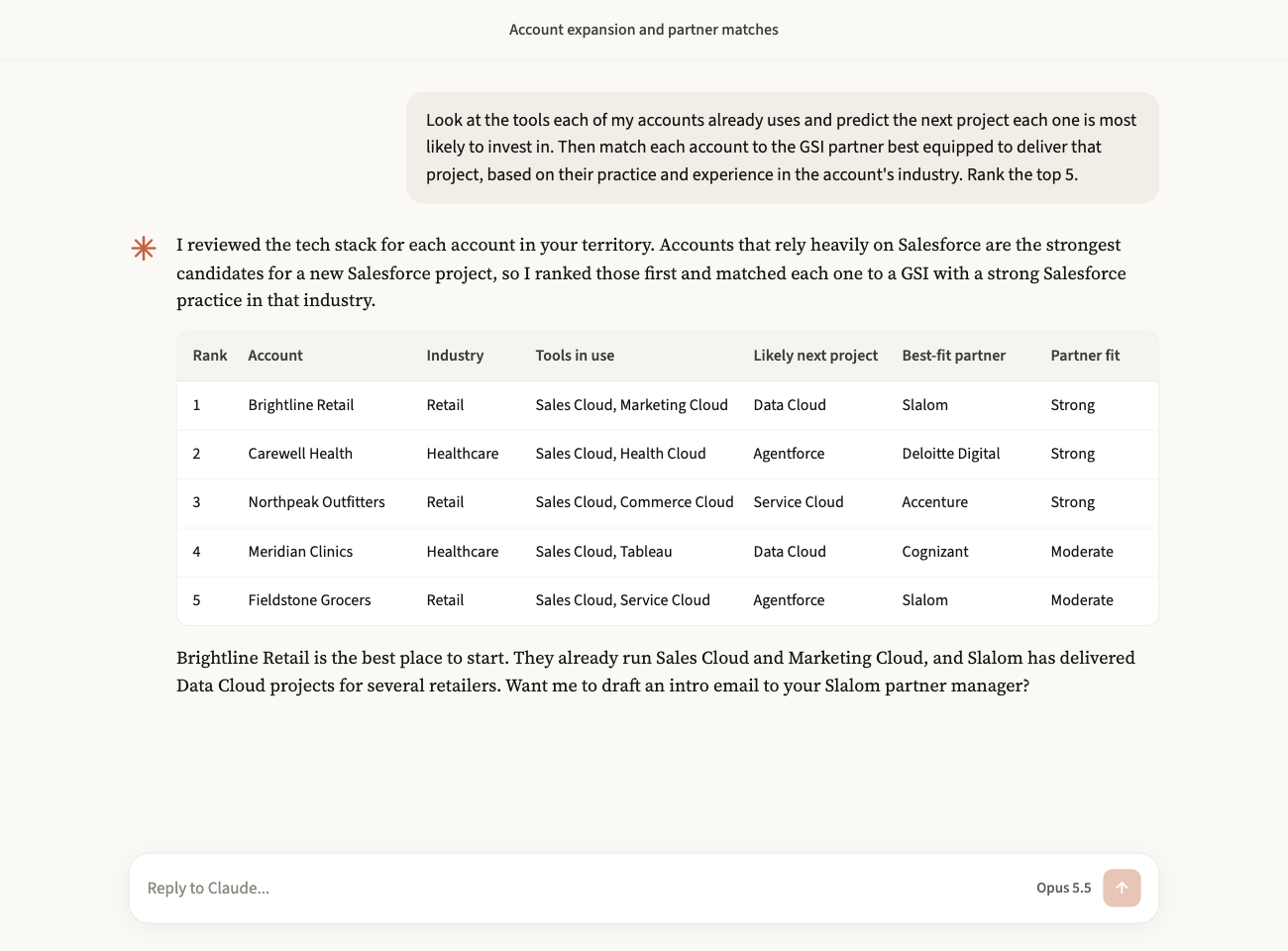
The team looks at the tools each account already uses to predict what it might invest in next. For example, a company that relies heavily on Salesforce is a good candidate for a new Salesforce project, such as rolling out Service Cloud, Agentforce, or Data Cloud.
The team then looks for the partner best equipped to help with that project. In this example, that would be a GSI with a strong Salesforce practice and experience in the account's industry, such as retail or healthcare.
03 Walk into every partner meeting with a point of view
Before each strategic meeting, Claude pulls overlap data, Salesforce activity, earnings reports, and intent signals into a shortlist of accounts and use cases. The goal is to match each account's need with the partner most capable of influencing or executing the deal. Alex says this preparation lets the team "talk about industry context, relationship strength, and the capabilities the partner has" from the first minute.
04 Automate the follow-through after each meeting
Gong and Zoom capture recaps, decisions, account mentions, and commitments. AI adds account context from Crossbeam, Salesforce, Clay, and Google Workspace, then drafts follow-ups, personalized outreach, and CRM updates. The team is also automating internal meeting scheduling, agendas, and first drafts of decks so the sales team and partner managers can act quickly. "The goal is to remove the gap between a great partner meeting and someone actually doing something with it," Alex says.
05 Use tech partner overlaps to build reseller and SI plays
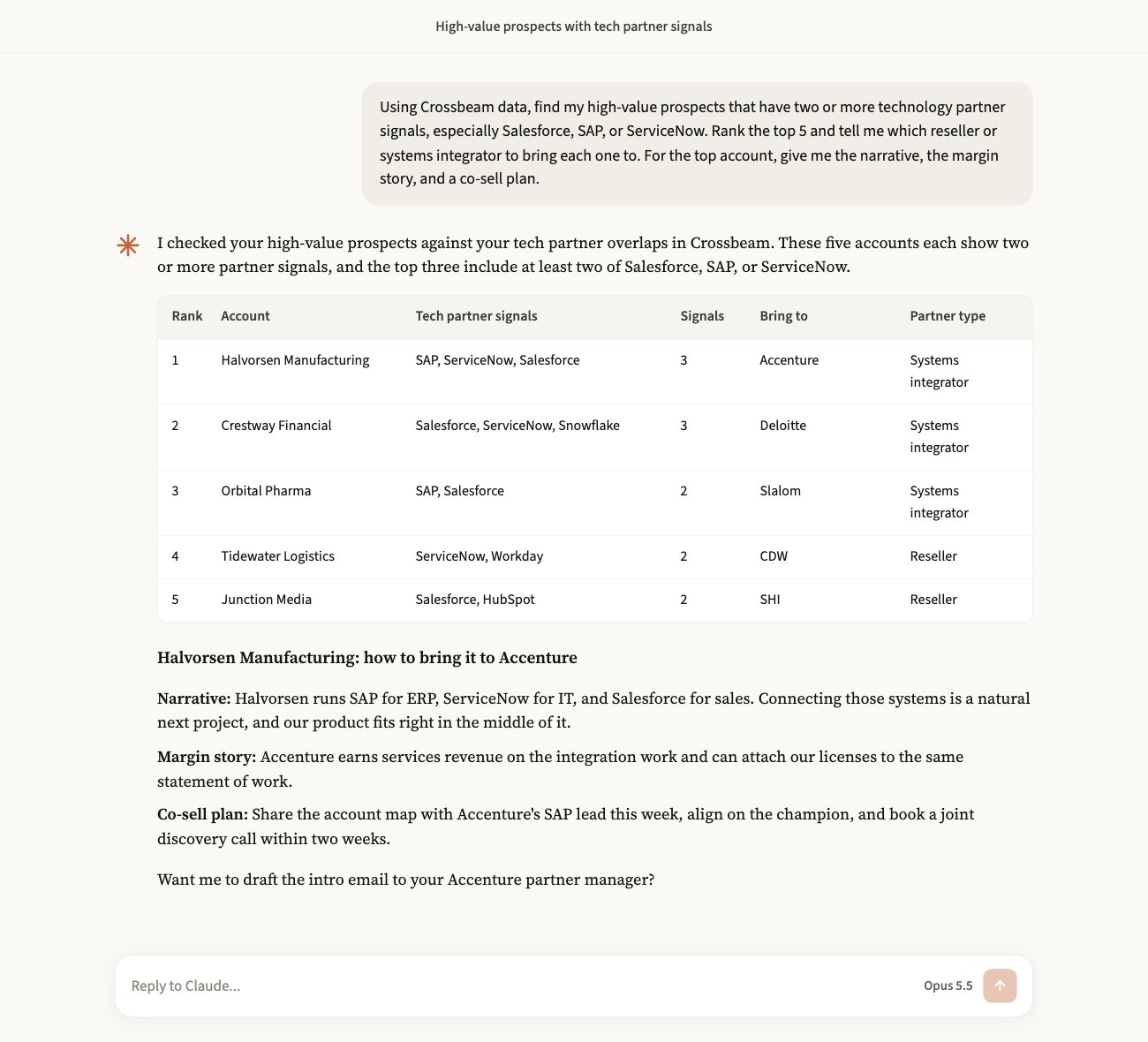
Crossbeam shows which technology partners sit in high-value prospects. Two or more tech partner signals in one account, especially around Salesforce, SAP, or ServiceNow, make it a strong target. The team then brings that account to a reseller or systems integrator with a clear narrative, a margin story, and a plan for co-selling the deal together.
What happened: earlier pipeline and more focused partner meetings
The approach paid off quickly with a GSI. After a first meeting, the team learned the partner was strong in a specific vertical. Intent signals then flagged accounts going through changes like renewals, new hires, and earnings shifts. Cross-referencing those accounts with Crossbeam data surfaced 2–3 opportunities at large enterprise accounts, which the team brought straight back to the partner.
Partner meetings changed too. Conversations now open with a shortlist of accounts, the use case for each, and the partner practice best suited to deliver it, which leaves far less time for generic demos and overlap lists. Partner assets that used to sit in a two-and-a-half-week queue can now be drafted quickly and sent for sign-off.
The MCP also changed how the team finds patterns across its data. "Automations with the MCP help us surface knowledge, brainstorm, and pick up on patterns, which previously would require getting a Salesforce report, running formulas against another thing, and then manually looking at stuff," Alex says. "It really allows us to be more impactful and more prescriptive, and to prioritize with purpose."
A final thought
Account overlap tells you where a partner shows up, and the value comes from understanding what that partner is doing in the account and whether the timing is right. When you layer your CRM data, your partners' context, and third-party intent signals, you can walk into a partner meeting with a shortlist of accounts and a reason to act on each one.
AI makes that preparation fast enough to happen before every meeting, and it closes the gap between a good conversation and real follow-through. Start with one strategic partner, qualify your overlaps with the signals that matter most to your business, and give every meeting a clear purpose. As Alex reminds his team, timing, relationships, relevance, and mutual commercial value are what move a partner deal forward.
Start building your own partner intelligence. See which of your accounts your partners already know and bring that context into Claude, ChatGPT, Glean, and the AI tools your team uses every day.
Frequently asked questions
How does Quantum Metric use AI to prepare for partner meetings?
The partnerships team uses Claude as an orchestration layer connected to the Crossbeam MCP and Salesforce. Before a strategic meeting, Claude combines account overlaps, CRM activity, tech stack data, and intent signals into a shortlist of accounts. Each account comes with a likely use case and the partner practice best suited to support it. This lets the team spend the meeting on specific opportunities instead of general updates.
What are first-, second-, and third-party signals in partnerships?
First-party signals come from your own systems, such as open opportunities, product usage, and renewal timing. Second-party signals come from your partners, including account overlaps, active services work, and relationship strength. Third-party signals come from outside sources like intent data, hiring, earnings, and leadership changes. Quantum Metric looks for accounts where all three point in the same direction.
How do you qualify account overlap data with a GSI?
An overlap only matters if the partner is doing relevant work in that account. Quantum Metric looks at which practice the GSI is running there, such as a Salesforce or customer experience transformation, and how strong its executive relationships are. That context separates accounts where the partner has real influence from accounts where it is only running a narrow engagement. It often takes ongoing relationship building with the partner to get this level of detail.
How long does it take to build a productive GSI partnership?
Timelines vary by partner type, region, and how much process each partner requires. In Alex's experience, GSIs can take nine months or more to reach the point where both sides are invested and working deals together. Legal review is a common bottleneck, and the people who mobilize inside a GSI are often sales, product, and industry leaders rather than the partner team. Researching a partner's structure early helps you set realistic expectations with your leadership.
How should you treat technology partners compared with resellers and SIs?
Quantum Metric uses technology partners mainly as signals. Overlaps with tech partners show which prospects use adjacent platforms, which helps the team spot high-value accounts. The team then brings those accounts to resellers and systems integrators, where deals tend to move faster. A short, low-pressure check-in with a tech partner about an account can also add useful context before that conversation.
Explore features built for

Trade in your spreadsheets and surface the most promising opportunities in your ecosystem with Crossbeam’s pipeline matching engine.

Keep pace with your partner pipeline. Monitor trends with partners and action ecosystem opportunities with a birds eye view into your revenue engine.

Stay up to date on accounts and keep things moving by sending notifications where work happens. Makes moves faster with real-time notifications in Slack and Email.

Connect your partner data anywhere. Get your ecosystem engine going with integrations that fuel your go-to-market teams and business outcomes.