How Adobe turned partner data into pipeline for a 5,000-person sales team
- AI-layered co-sell scoring (Partner IQ)
- Exposing overlap data to partners who didn't yet have a dedicated Partner Manager
- Pulling historical closed-lost deals to quantify how much revenue ($2B) had a partner attached, used to win sales leadership buy-in
- Formalizing account mapping as a partner program benefit



Adobe is a 30,000-person company with $24 billion in revenue, more than 5,000 sellers, dozens of products, and dozens of geographies, which also works with hundreds of partners.
For years, David Meyers, Senior Manager, Technology Partner Program at Adobe, said that scale worked against the partnerships team rather than for it: sellers found one or two partners they liked working with on a given deal, kept going back to the same ones, and word of mouth did the rest.
"There are dozens of geos that we sell in, and there are hundreds and actually thousands of partners," David said. "So it's really hard to get this partner ecosystem wrangled to the place where it can be effective."
David leads Adobe's collaboration between partnerships and sales, and won this year's Strong Collaboration with Sales Award for turning that collaboration into a repeatable system, built without the one integration most Ecosystem-Led Growth programs rely on to reach sellers in the first place.
The problem: no Salesforce integration and no easy way to reach sellers
Adobe doesn't use Salesforce; it uses Microsoft Dynamics. That meant the standard path most companies use to get Crossbeam data in front of sellers wasn't available to David's team from the start — now, you can connect Microsoft Dynamics as your data source.
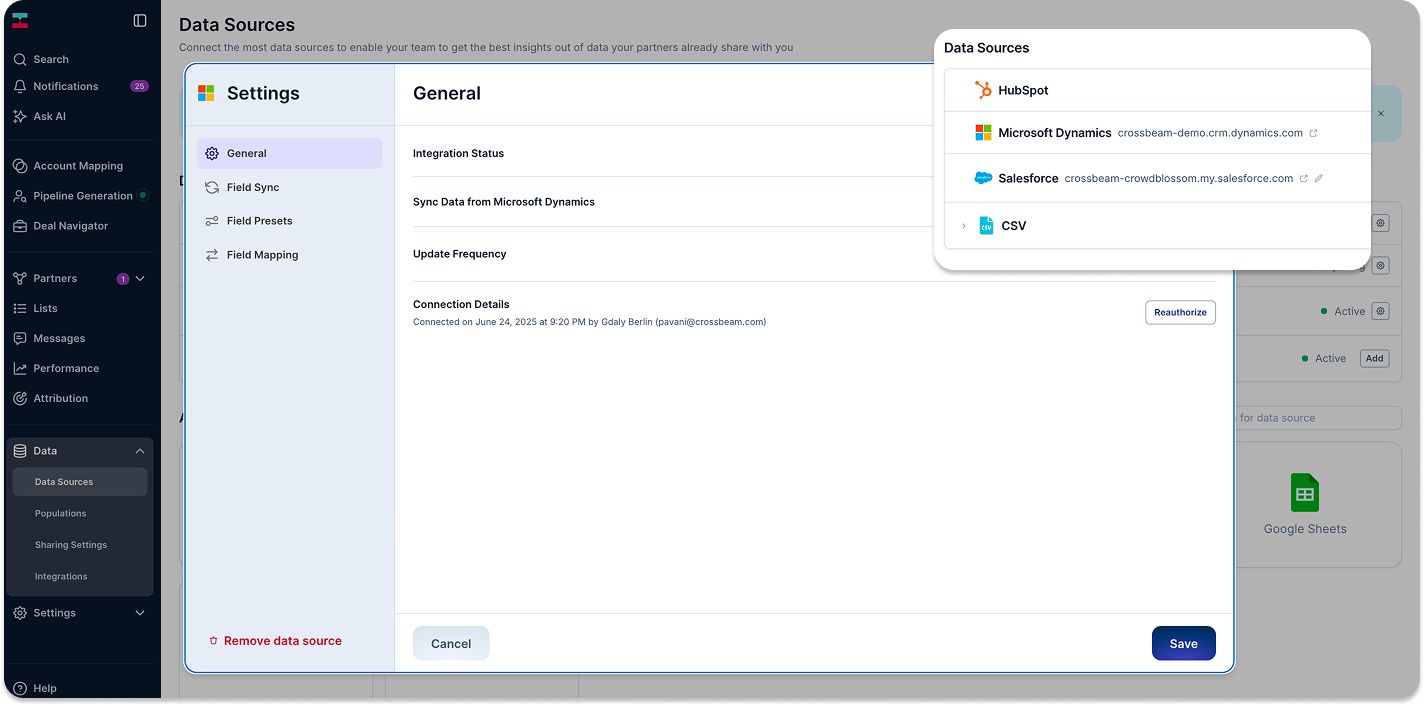
As a workaround, the team pulled Crossbeam data through Snowflake and various SQL databases — the kind of pipeline work a RevOps team typically owns — that feed Adobe's CRM system. David said that the setup alone took a year to build before any partner or seller saw its benefits.
How Adobe built co-sell scoring into everyday sales work
Once the data pipeline existed, David's team still had to earn buy-in from partners and sales leadership separately, then connect the two.
01 Get the data flowing before asking anyone to use it
With the Snowflake-to-Dynamics pipeline in place, the team had a foundation to expose to partners and sellers, even without a native Salesforce connection.
02 Recruit the partners who had the most to gain
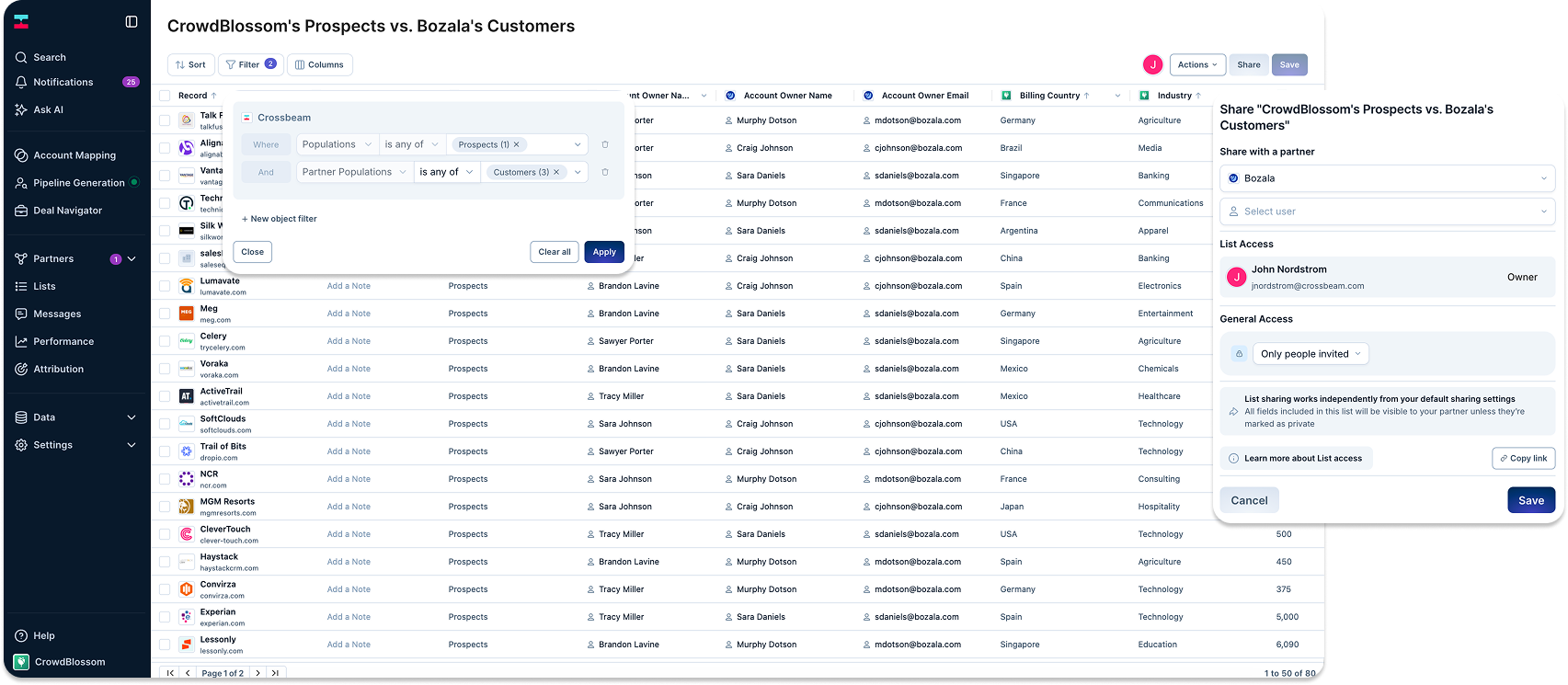
Partners that already had a designated Partner Manager were already doing account mapping directly with that person, so they saw little reason to restart the process. David's team started instead with partners that didn't have a Partner Manager. His team exposed them to select shared lists of overlap data and built the relationship from there. Reaching a critical mass of partners on Crossbeam took about a year.
03 Prove the case with the deals that were already lost
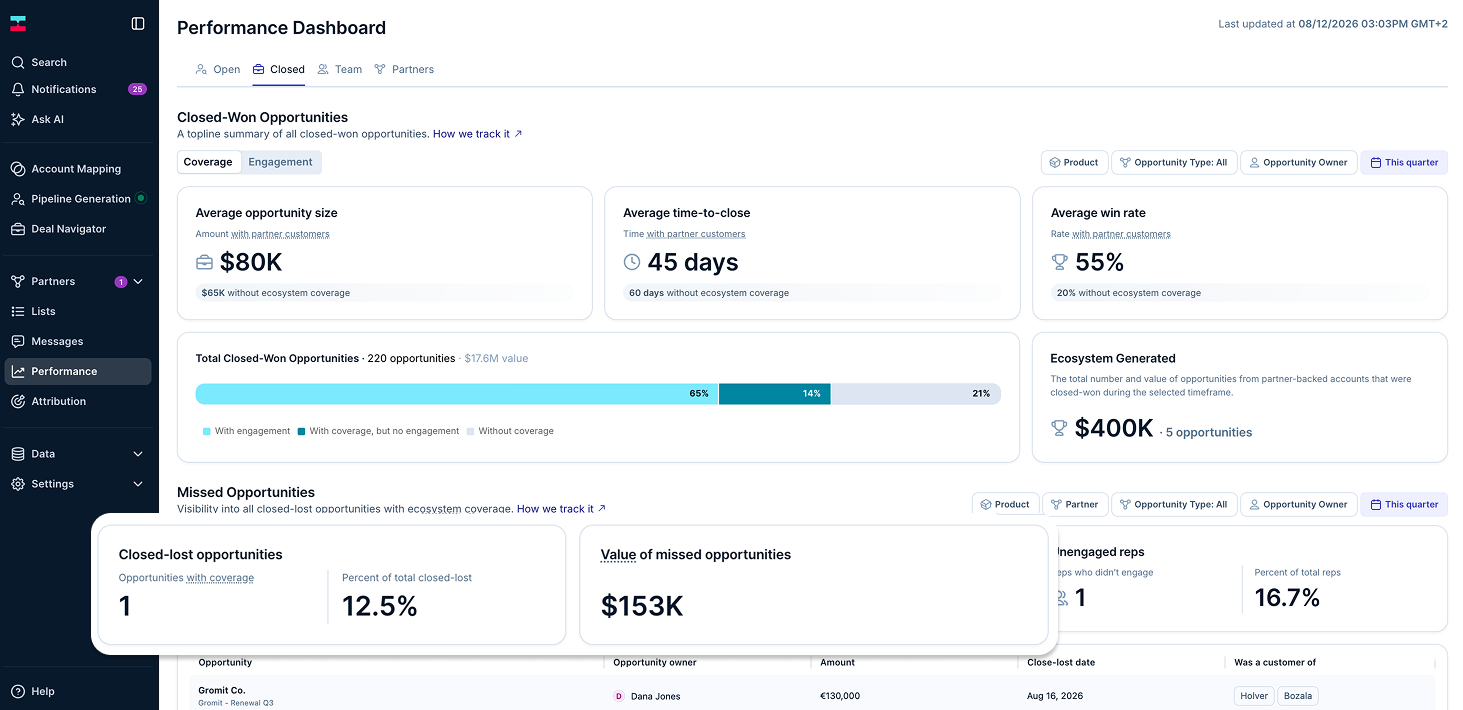
Once a critical mass of partners was in Crossbeam, David's team pulled a number that got sales leadership's attention. "Once we had a sort of critical mass of partners in Crossbeam, we had to show sales leadership, hey, of the closed lost business you had last year, over $2 billion of that had a partner in it, and you could have leveraged them," David said. That data, echoing the kind of case laid out in Crossbeam's sales leader playbook, got sales leaders intrigued enough to run a pilot with one group.
04 Expand in stages, then make account mapping a program benefit
True to the advice to start small with one motion before scaling, the team tested with a group of technology partners first, then with solution partners, and finally with a larger sales group. Adobe later folded account mapping into its partner program benefits and hired a dedicated account mapping specialist, Elizabeth Whalen. That single hire helped triple the number of solution partners in the program.

05 Layer AI on top of the ecosystem data
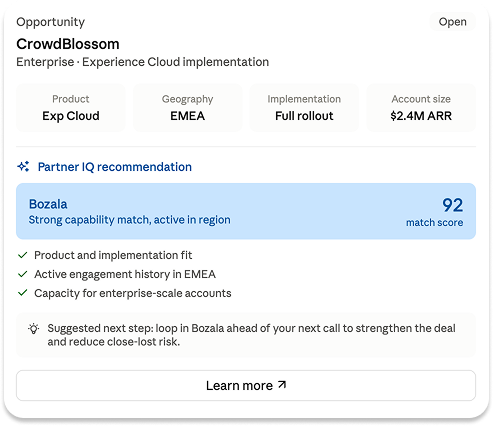
Adobe built an internal tool, Partner IQ, that interprets Crossbeam data for sellers, doing for Adobe's sales team something similar to what other customers get out of Crossbeam Copilot.
"We've layered on an AI layer interpreting our Crossbeam data, and really looking forward to incorporating the Crossbeam MCP into that so that our sellers can have conversational interactions with it; it's called Partner IQ," David said.
The tool weighs the product, geography, implementation type, and account size, then compares that against partner capability and engagement, with the relationship data coming from Crossbeam, to score and return a recommendation.
What happened: from a one-year data project to a sales habit
What started as a year-long data pipeline project became a staged rollout that touched Adobe's partner program, its sales organization, and eventually an AI layer built on top of both.
The number of solution partners in Adobe's program tripled after the team added account mapping as a program benefit and brought in a dedicated specialist to manage it.
Sales leadership, once shown how much closed-lost revenue had a partner attached, moved from skepticism to running pilots, then expanding those pilots across bigger groups of sellers, a version of the GTM motion shift Crossbeam sees across most Ecosystem-Led programs.
A final thought
If you're building account mapping into a partner program that spans different partner types, know that the hardest part isn't the technology; it's agreeing on the definition.
"Knowing what a tech partner's customer is, or a software company's customer is, is easy. They subscribe to the software. It's either yes or no," David said. "But knowing what the customer of a Systems Integrator is, is harder." A company that a systems integrator implemented a different product for years ago might or might not count as a current customer, and David shared that Adobe had to work through that definition directly with each partner, since the same partner might apply a different standard with every other company they use Crossbeam with.
Getting that definition right matters because it determines whether your sales team trusts the data at all. "If you can make sure that data is accurate, when it comes to your sales team, they'll begin to trust it more," David said. The more accurate the underlying data, the more your sellers will actually use it, and the sooner it turns into pipeline instead of sitting in a platform nobody opens.
See what Account Mapping and AI could surface in your pipeline
It took Adobe four years to build this by hand. With Crossbeam, you can start spotting partner overlap in your deals before they turn into closed-lost. Book a demo to see how.
Frequently asked questions
Why didn't Adobe rely on a Salesforce integration to share Crossbeam data with sellers?
Adobe doesn't use Salesforce, so the standard integration path wasn't an option. The team instead pulled Crossbeam data through Snowflake and SQL databases that feed Adobe's CRM system, Dynamics, which took about a year to build before it reached any partner or seller. However, now Crossbeam has a native integration with Microsoft, so you can use Dynamics as your data source.
Why did Adobe start with partners that didn't have a partner manager?
Partners that already had a partner manager were already doing account mapping through that relationship. David's team found more traction starting with partners who lacked that resource, then expanding from there once value was proven.
What is Partner IQ?
Partner IQ is an internal tool Adobe built to interpret Crossbeam data for its sales team. It scores which partners are the best fit for a given account based on product, geography, implementation type, and account size, weighed against partner capability, engagement, and the relationship data pulled from Crossbeam. David said the team is looking forward to incorporating the Crossbeam MCP into it next.
Explore features built for

Trade in your spreadsheets and surface the most promising opportunities in your ecosystem with Crossbeam’s pipeline matching engine.

Keep pace with your partner pipeline. Monitor trends with partners and action ecosystem opportunities with a birds eye view into your revenue engine.

Stay up to date on accounts and keep things moving by sending notifications where work happens. Makes moves faster with real-time notifications in Slack and Email.

Connect your partner data anywhere. Get your ecosystem engine going with integrations that fuel your go-to-market teams and business outcomes.