How Fundraise Up Turned Trust and Ecosystem Intelligence Into a 30% Revenue Outperformance
- Identifying high-impact agency partners
- Prioritizing partners based on real account overlap
- Triggering co-selling motions
- Using ecosystem data to guide co-marketing and event strategies


When Jamie Mueller, VP of Partnerships at Fundraise Up — a digital donation platform that helps nonprofits grow by improving online donor conversion — joined in April 2024, the partner org was a team of three, driving around 30% of the company's revenue.
Eighteen months later, the team has grown to 12, the company scaled from 150 to 300+ employees post–Series B, and partnerships now generate 69% more pipeline year over year and is on track to exceed its channel revenue goal by double digits.
The shift? Use partners not only to “source” referrals but also as influence multipliers with Crossbeam at the center.
“We’re going to be generating a lot more pipeline, and then support and influence even more of our company’s pipeline,” said Jamie. “We realized we were under-leveraging our partners once an opportunity was already in motion.”
The path wasn’t straightforward. Fundraise Up sells into a nonprofit market where trust is everything, and the partners who hold that trust are also the hardest to operationalize.
Agencies often resist account mapping, hesitate to share data, and require high-touch relationship building. Before Jamie stepped in, the partner program wasn’t fully tapping the power of ecosystem insight, making it difficult to scale predictably.
Read on to learn how Fundraise Up scales trust and pipeline with Ecosystem Intelligence to drive more revenue.
The challenge: Trust-based agencies and data-sharing friction
Fundraise Up’s ideal customers rely heavily on agencies, fundraising strategy firms, selection consultants, and SIs in the Salesforce and HubSpot ecosystems. These firms are deeply embedded in nonprofit operations and often hold the closest advisory relationships.
“The number one thing we receive from our agencies is endorsement credibility and shared trust,” said Jamie. “They’re a huge sounding board that exponentially increases feedback.”
This translates to real impact: a partner-involved deal boosts Fundraise Up’s win rate by double-digits and even more when two partners are involved.
But the agencies that offer the most trust often introduce the most friction.
Agencies are not built around partnership motions, and many are uncomfortable sharing client lists, especially in ecosystems where dozens of competitors overlap.
“There’s ingrained distrust in sharing client lists,” said Jamie. “We overcome it by being malleable, accepting list uploads instead of CRM connections, and by sharing first to set the tone.”
Fundraise Up’s team learned to meet agencies where they are:
- CSV uploads instead of CRM syncs
- One-time snapshots instead of continuous sharing
- Trigger-based updates (events, campaigns, co-marketing)
- Leading with vulnerability to model healthy sharing
This choice, lowering the barrier to mapping, became essential to scaling the ecosystem motion.
Solution: The trust-building motion
Jamie’s team treats partners like customers. They created a motion based on intentional outreach, discovery, and a clear plan. Here’s how it goes:
- Outbound-first targeting of high-overlap agencies.
- Margin protection messaging (contract-free, no upfront fees).
- Mutual discovery of business goals and shared motion.
- Alignment on partnership type (formal or lightweight).
- Consistent enablement, like orientation sessions, PRM access, quarterly meetings, and town halls.
How Fundraise Up leverages Ecosystem Intelligence
Scaling a partner ecosystem in the nonprofit sector requires precision.
Agency relationships are deeply personal, and every partner motion needs to deliver clear value. Crossbeam became the connective tissue that allowed Fundraise Up to target the right partners, activate them at the right moments, and embed Ecosystem Intelligence directly into sales workflows.
Here’s the step-by-step process Jamie’s team uses to operationalize ecosystem data across partnerships and sales.
1. Identify target partners through public signals.
In the nonprofit world, vendor relationships are surprisingly transparent. Fundraise Up begins by analyzing publicly available data like CRM usage, agency affiliations, fundraising consultants, and digital strategy firms tied to large nonprofits.
They match this data against their own ICP to create an early prioritized list. This pre-Crossbeam filtering ensures the team only maps with agencies already proven to be active in their segment.
2. Validate fit and prioritize with Crossbeam account overlaps.
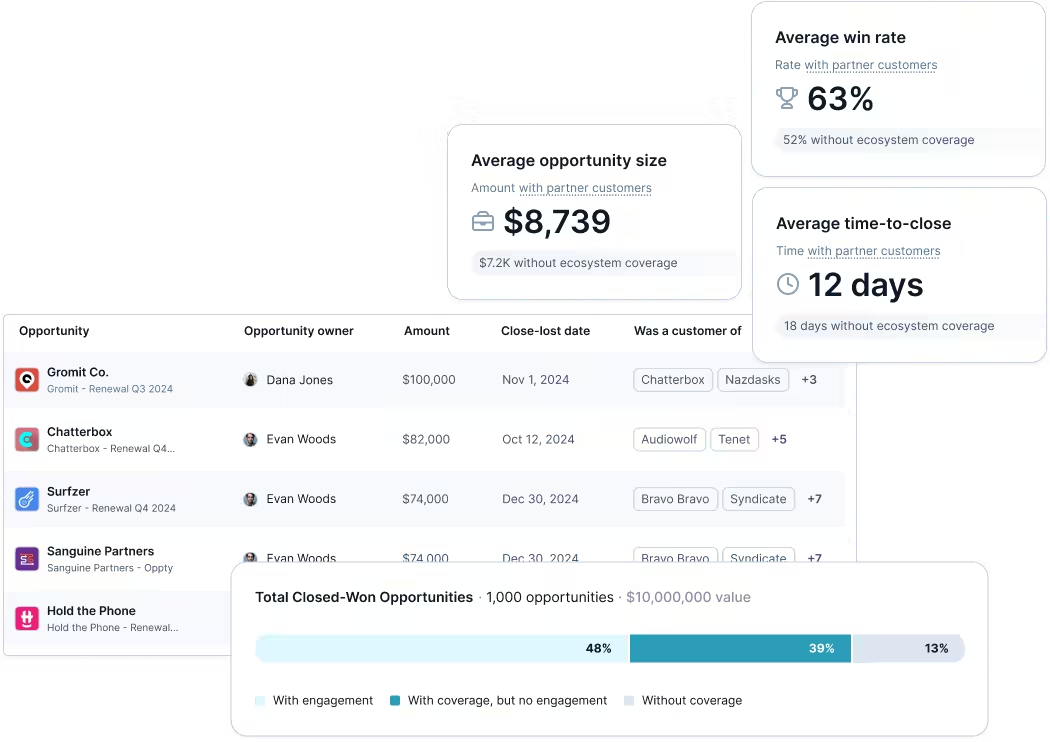
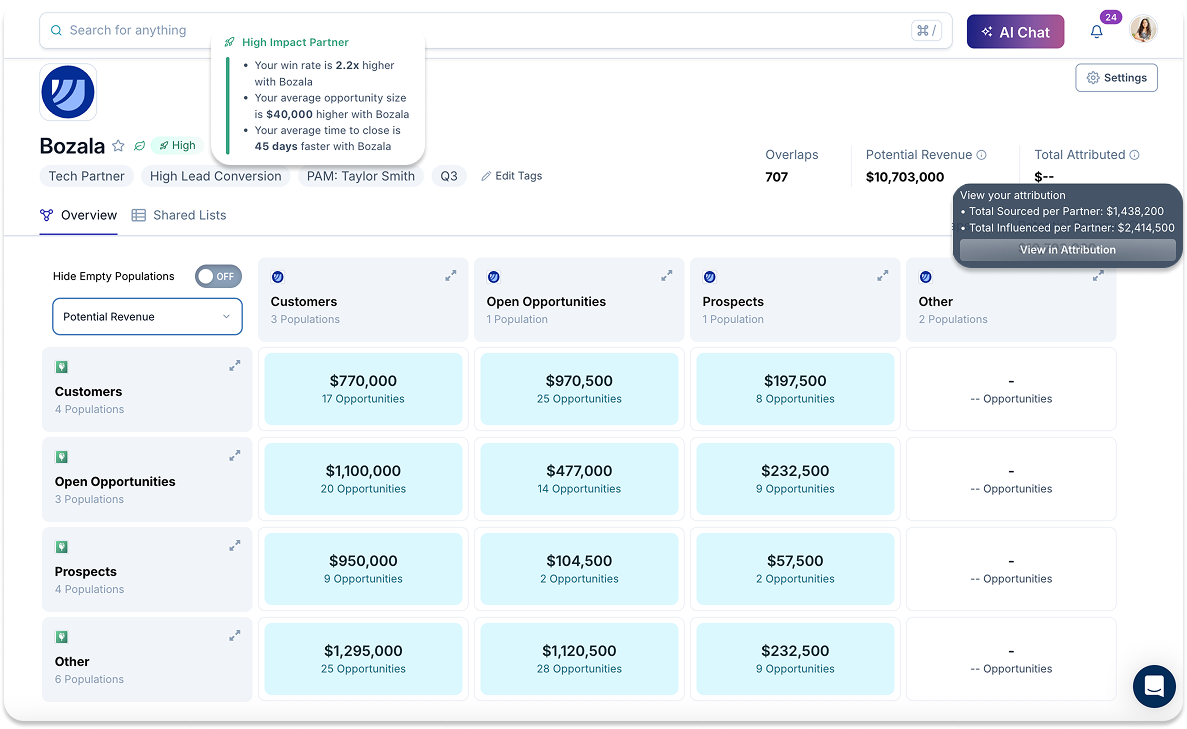
With a potential list in hand, Jamie’s team turns to Crossbeam account mapping to confirm whether real overlap exists. Because the top of the nonprofit market consists of about 100 major organizations, even a single major account overlap can justify prioritizing a partner.
Fundraise Up looks at:
- Which agencies appear most frequently across key prospects and customers
- The depth and quality of overlaps (not all mutuals matter equally)
- Crossbeam’s partner scoring indicators to understand “best partner for this account.”
3. Lower the mapping barrier with CSV uploads and “snapshots.”
Agencies often resist CRM-to-CRM mapping, so Fundraise Up makes it easy by offering alternative methods:
- CSV uploads of client lists (by leveraging Crossbeam Offline Partners)
- Event registration lists
- Periodic snapshots of who they’re working with
These uploads are done on a trigger basis (before an event, a co-marketing campaign, or a joint outreach push) so partners never feel like they’re handing over a full, continuous client list.

4. Score potential partners with a partner fit rubric.
Once mapping reveals real overlap, partner managers use a formal rubric to determine whether a partner earns a place in their “book.” The rubric includes:
- Crossbeam mapping strength
- Partner’s willingness to engage or share
- Clarity of the partner’s business model
- Ability to articulate mutual value
- Early behavior signals (responsiveness, interest level, etc.)
High-potential partners are assigned to a PM’s book of 25–60 partners, depending on size and strategic weight.
5. Bring Ecosystem Intelligence directly into sales workflows.
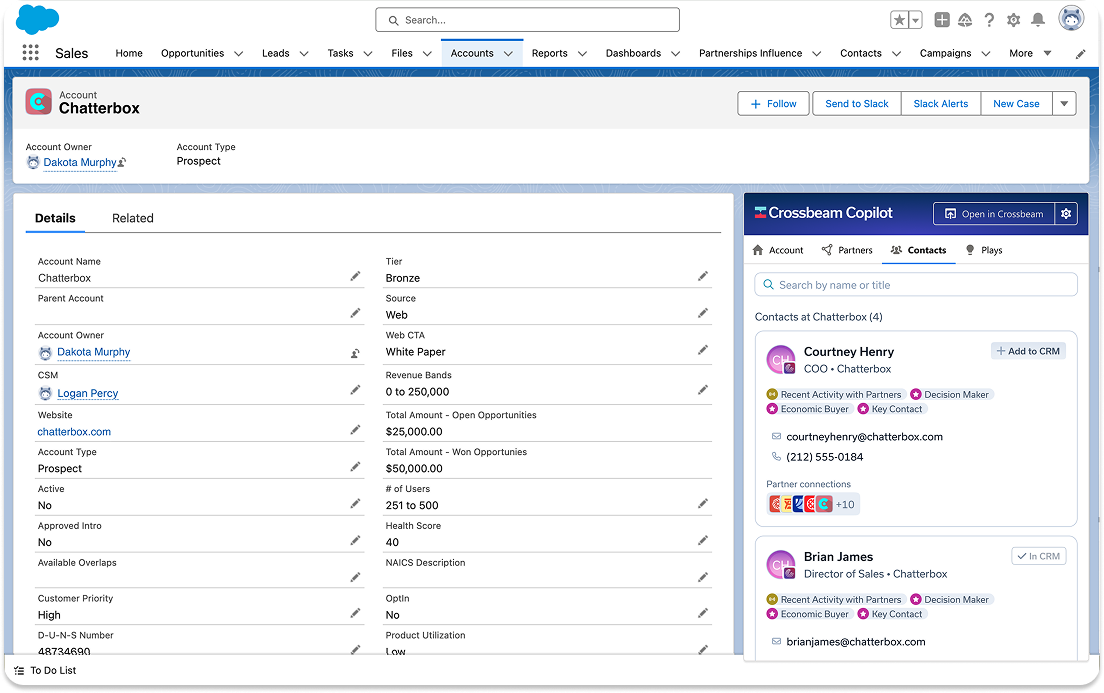
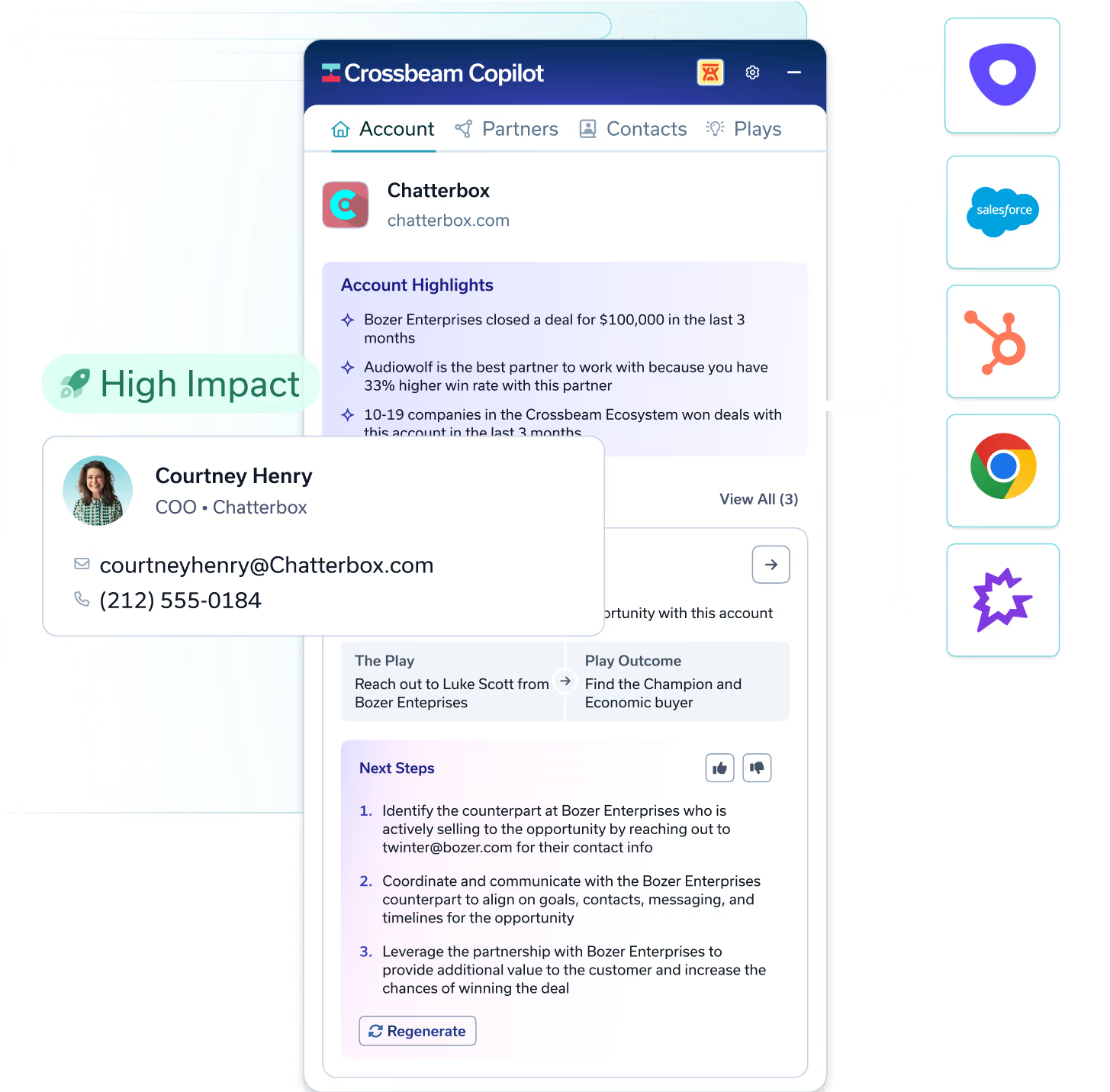
Jamie’s team ensures both PMs and sellers can access insights in real time. For example, AEs use the Crossbeam Copilot widget inside Salesforce to:
- View the mapped agencies connected to the account
- Identify who to pull into active deals
- Request partner intros or third-party validation
- Spot previously hidden influence paths via agency relationships
6. Build enablement that scales.
With the right partners identified, mapped, and activated, Jamie’s team uses a lightweight enablement engine to keep the ecosystem aligned. Their enablement model includes:
- Frictionless onboarding: New partners receive short orientation emails and direct access to resources in the PRM so they can get context without a lengthy training process.
- Optional monthly orientations: Partners who want a deeper understanding of the product or referral motion can join live sessions, but these are never a requirement to participate.
- Quarterly partner manager check-ins: Every partner in a PM’s book receives at least one strategic conversation per quarter to review mapped overlaps, opportunities, and Crossbeam insights.
- QBRs for high-potential partners: When a partner shows strong alignment or overlap, PMs run formal Quarterly Business Reviews to plan co-selling and co-marketing motions driven by Crossbeam data.
- Bi-monthly partner town halls: These sessions bring partners into the broader ecosystem narrative, like product updates, GTM priorities, functional leaders, and industry insights.
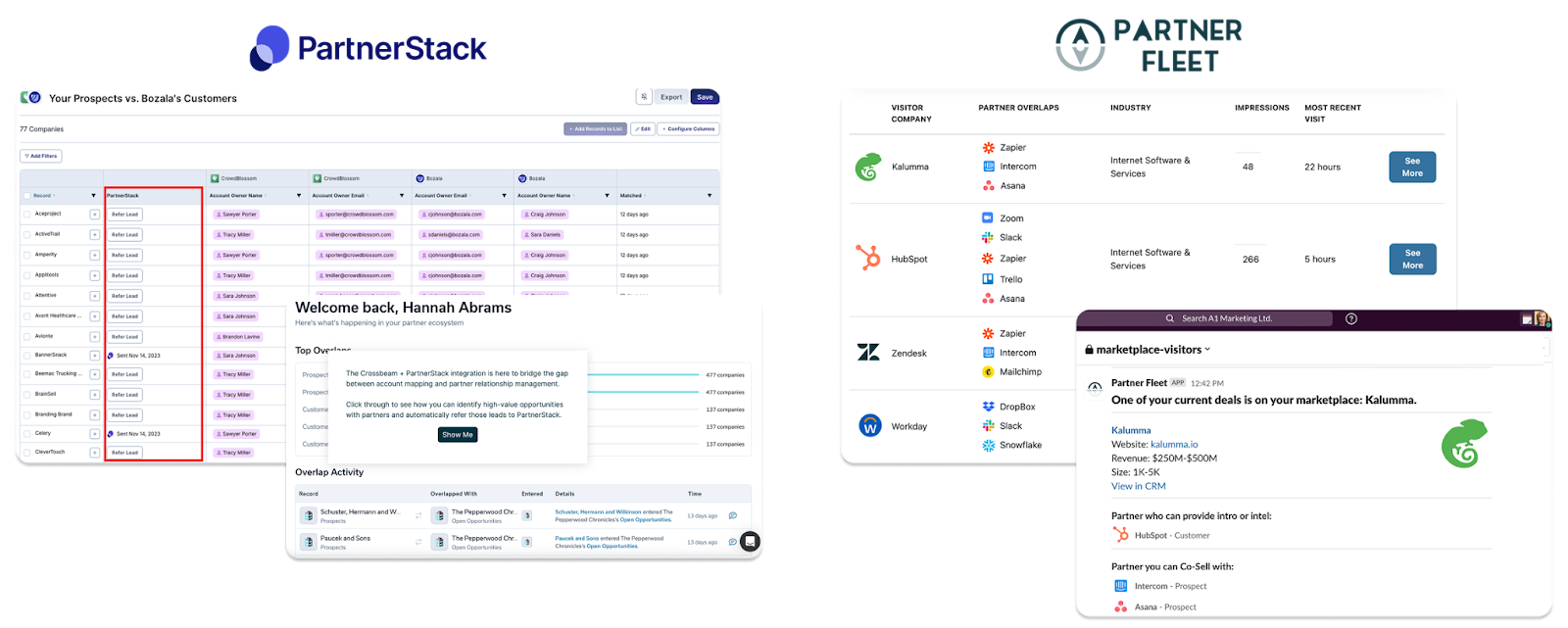
- A modern, integrated tooling stack: Fundraise Up connects its partner workflows across Crossbeam, PartnerStack, Partner Fleet, and Salesforce, ensuring ecosystem intel flows cleanly into referral management, listings, and sales execution.
7. Trigger co-selling motions to increase win rates.
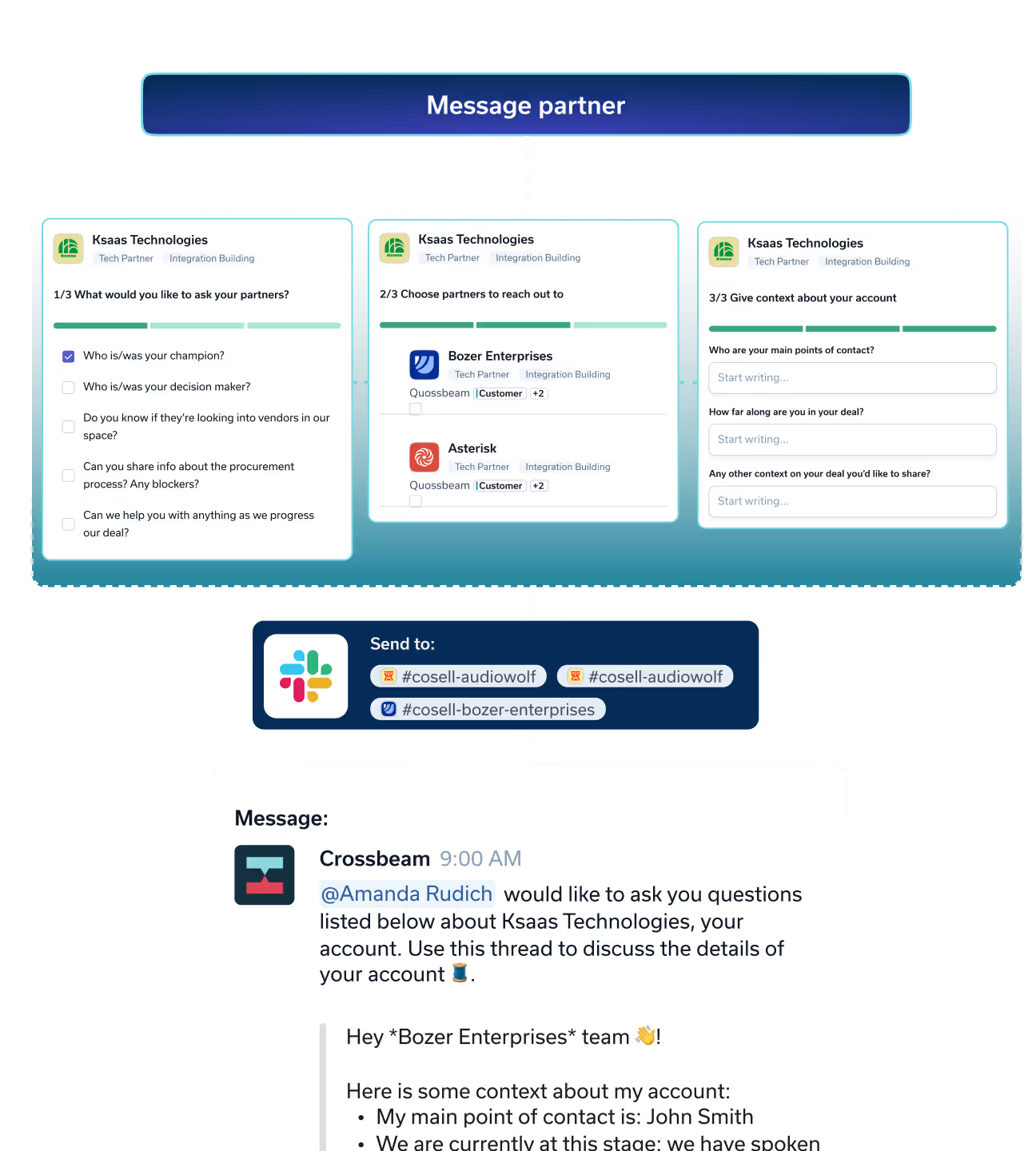
Once an opportunity enters the pipeline, PMs proactively contact mapped partners to join the motion. This can include:
- Validation calls to help build trust
- Joint messaging
- Co-marketing support
- Shared presence in meetings
- Third-party case studies or industry context
8. Maintain momentum through quarterly ecosystem reviews.
PMs review Crossbeam overlaps quarterly with top partners, looking at:
- Shifts in shared accounts
- New co-selling opportunities
- Co-marketing triggers
- Pipeline impact
- Areas where CSV snapshots need refreshing
These conversations reinforce accountability and keep both teams aligned on shared goals.
Results
Fundraise Up turned its partner ecosystem into a force multiplier for the entire revenue engine:
- The partner team grew from 3 to 12
- The pipeline increased 69% YoY
- Win rates climbed by double-digits when partners are involved (and it’s even higher when two partners collaborate)
- The Partnerships department is tracking revenue 30% above plan, even with 80% of the team being new this year.
The result is an ecosystem that doesn’t just support Fundraise Up’s growth, it propels it, amplifying every part of the revenue engine and proving that when trust, data, and alignment come together, partnerships can become a company’s most strategic lever.
Jamie’s advice to partner leaders
As Fundraise Up’s ecosystem continues to scale, Jamie’s guidance for others building a similar motion is refreshingly grounded and rooted in the realities of growing a partner program from the ground up.
The first lesson is about focus. Not all partners are created equal, and not all relationships deserve the same amount of attention.
“Have a consistent balance between transactional and strategic relationships and know the difference between them,” Jamie explained. “Deploy your resources in an 80/20 philosophy. Spend 80% of your time on the strategic partners that are going to help you generate revenue for the long term. Spend 20% on your transactional ones, they’ll bring in revenue anyway because it supports their business.”
Her second lesson is all about executive alignment. Partner teams often fall into the trap of speaking in partner-first metrics like logos, activities, and certifications, none of which translate naturally to what the C-suite cares about.
“Learn how to talk to your executive team in ways they care about. They don’t care about the number of partners you have,” said Jamie. “They care about the revenue and pipeline you’re bringing to the table, and how you contribute to the bottom line. You have to translate your activity into those outcomes.”
Fundraise Up cracked one of the hardest motions in the nonprofit sector: partnering with trust-driven agencies that resist data sharing. With Crossbeam, they built a scalable, influence-led model that drives pipeline growth (YoY) and lifted win rates dramatically.
Want to build the same motion? Book an ELG Strategy Call to see how ecosystem intelligence can power your growth.
Explore features built for

Trade in your spreadsheets and surface the most promising opportunities in your ecosystem with Crossbeam’s pipeline matching engine.

Keep pace with your partner pipeline. Monitor trends with partners and action ecosystem opportunities with a birds eye view into your revenue engine.

Stay up to date on accounts and keep things moving by sending notifications where work happens. Makes moves faster with real-time notifications in Slack and Email.

Connect your partner data anywhere. Get your ecosystem engine going with integrations that fuel your go-to-market teams and business outcomes.